Substrate & drainage
A suitable substrate forms the foundation of a healthy root environment. It supports the plant and determines how much water and air remain available around the roots. Drainage allows excess water to leave the root zone.
A good substrate retains sufficient moisture while also maintaining air and structure. The right composition depends on the plant, the conditions and whether it is used in a pot or in the open ground.
What are substrate and drainage?
What is meant by substrate?
Substrate is the material in which a plant’s roots grow. For potted plants, it may consist of potting mix, coconut fibre, bark, perlite, pumice or a mixture of organic and mineral components. In the open ground, the existing soil forms the root environment.
The substrate supports the plant, retains water and allows air to reach the roots. Some components can also temporarily retain nutrients.
Its performance is determined by the mixture as a whole. Not only the materials used, but also their particle size, proportions and stability influence the result.
What is meant by drainage?
Drainage is the removal of excess water from the root zone. Water must be able to move through the substrate and then flow out of the pot or further into the surrounding soil.
For potted plants, the structure of the substrate, the drainage holes and the unrestricted outflow of water are particularly important. In the open ground, soil structure, underlying soil layers, compaction and the position of the planting site also play a role.
Good drainage does not mean that all water should disappear as quickly as possible. The substrate must retain sufficient moisture while allowing only the excess water to drain away.
Why do roots need both water and air?
There are pores between the particles of a substrate. Some contain water, while others contain air. Roots absorb water, but they also need oxygen to function normally.
When watering, many of these pores fill with water. Once the excess water has drained away, enough pores must contain air again. If almost all pores remain filled with water for a prolonged period, the amount of oxygen available around the roots decreases.
The desired balance between water and air differs between plants. There is therefore no single substrate that is suitable for every situation.
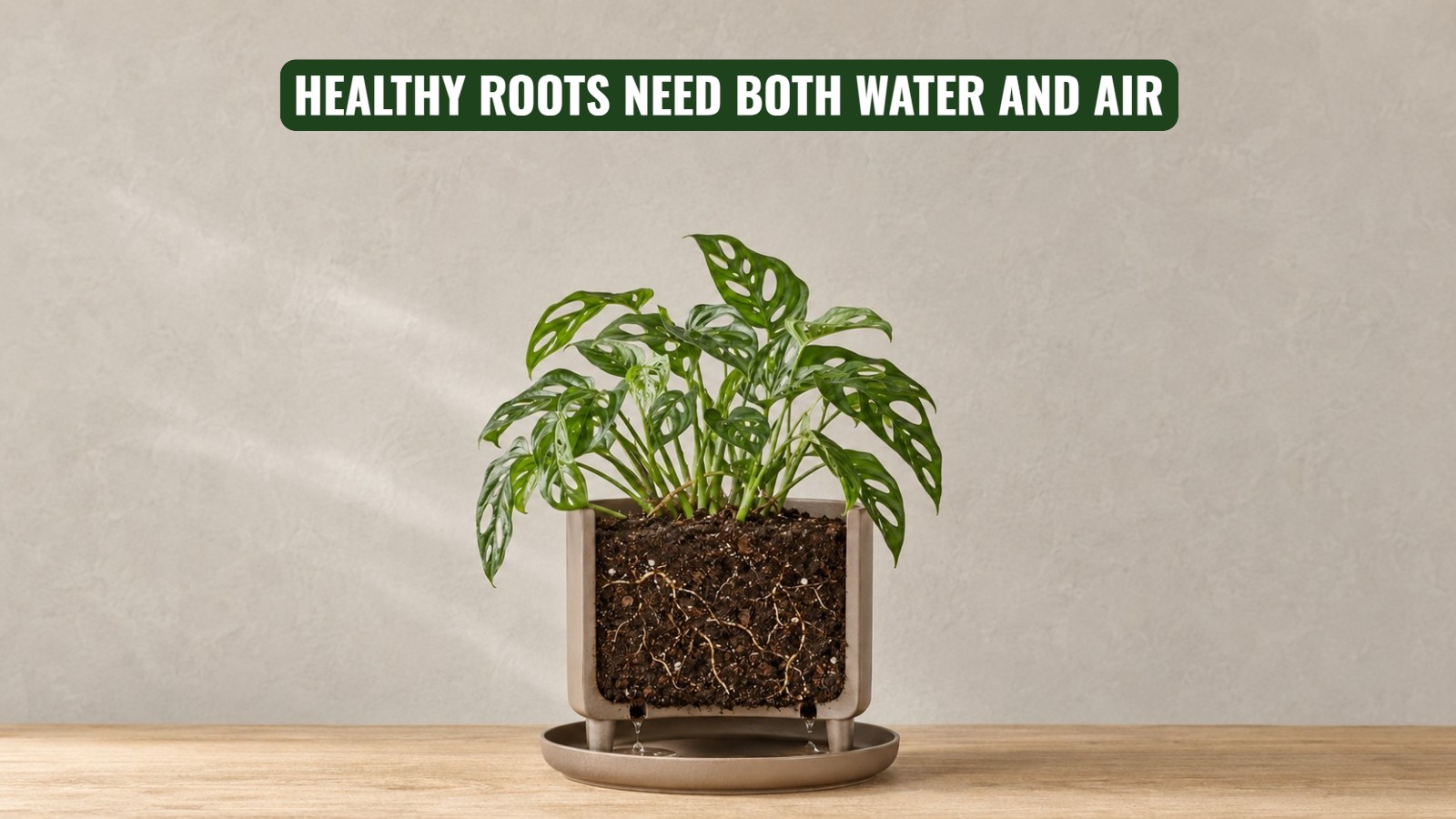
What properties should a suitable substrate have?
Absorb and retain water for long enough
A suitable substrate absorbs water, distributes it throughout the root zone and retains enough moisture for the plant.
Retaining more moisture is not always better. Some plants grow well in a consistently moist root environment. Other plants need more air around their roots and do not tolerate a substrate that retains a large amount of water for a prolonged period.
The conditions also have an influence. Heat, sunlight, air movement and the amount of substrate surrounding the roots all help determine how quickly the substrate loses moisture. The same mixture may therefore perform well in one location, while remaining wet for too long or drying out too quickly in another.
Drain excess water from the root zone
Excess water that is not retained by the substrate must be able to leave the root zone. This requires continuous pores and an unrestricted drainage route.
The surface may appear airy while a deeper layer is compacted. Water may also flow through the substrate properly, but then remain inside a closed decorative pot. The entire drainage route must therefore remain clear.
Extremely rapid drainage is not always beneficial either. If water barely penetrates the substrate or only flows away through cracks, the root zone may not be moistened evenly.
Maintain sufficient air around the roots
After drainage, some of the space between the substrate particles must contain air again. Larger, interconnected pores are particularly important for this.
However, a mixture containing coarse particles is not automatically well aerated. Fine material can fill the open spaces between them. Particles may also shift, break down or become more tightly packed over time.
How well aerated the substrate remains therefore depends on the combination and distribution of different particle sizes.
Maintain an airy and stable structure
A substrate must not only be airy at first, but must also retain this structure for a sufficiently long period.
Organic materials gradually break down. Fine particles may sink and fill the pores. This can cause the substrate to settle, become compacted or form a dense surface layer.
A stable mixture retains enough pores and does not quickly turn into a dense mass. How long the structure needs to remain stable depends on the plant, the period of use and when the substrate can be reassessed.
How do you determine which substrate is suitable for your plant?
The plant’s natural root environment
The plant’s natural habitat provides insight into the properties the substrate needs. Some plants grow in loose, organic soil that retains moisture while remaining airy. Other species occur in stony or mineral soils where excess water drains away quickly.
A naturally moist environment does not mean that the roots are constantly growing in saturated soil. Likewise, a plant from a dry region does not necessarily need to be kept completely dry.
Use the natural root environment as a starting point for determining how much moisture the substrate should retain and how airy and stable its structure should be. Also take into account the conditions in which the plant grows in your situation.
The moisture and oxygen requirements of the roots
A suitable substrate meets both the moisture and oxygen requirements of the roots.
Plants that need consistent moisture require a mixture that retains enough water without becoming dense. Plants whose roots need more air generally benefit from a more open substrate that drains excess water efficiently.
A moisture-retaining mixture can perform well as long as sufficient air-filled pores remain present. A very coarse mixture may be unsuitable if it retains too little water or distributes moisture unevenly.
The conditions in which the substrate is used
Substrate loses moisture more quickly in a warm, sunny or windy environment. In a cool, sheltered location with less light, the same mixture usually remains moist for longer.
Rain and changing weather conditions have an additional influence outdoors. A substrate that performs well during dry weather may retain too much water during prolonged rainfall if drainage is inadequate. A plant beneath a roof or canopy will receive less rainwater.
Indoor conditions also vary due to light, heating, air movement and seasonal changes. Always assess the substrate in combination with the plant’s actual location.
Use in a pot or in the open ground
In a pot, the volume of substrate is limited and water can only escape through the drainage holes. The relationship between the root ball, the amount of substrate and the drainage system therefore has a significant influence on moisture levels.
In the open ground, the root zone is connected to the surrounding soil. Water can move sideways and into deeper layers, provided that the soil structure allows it. Compaction, a poorly permeable subsoil or a high groundwater level can restrict drainage.
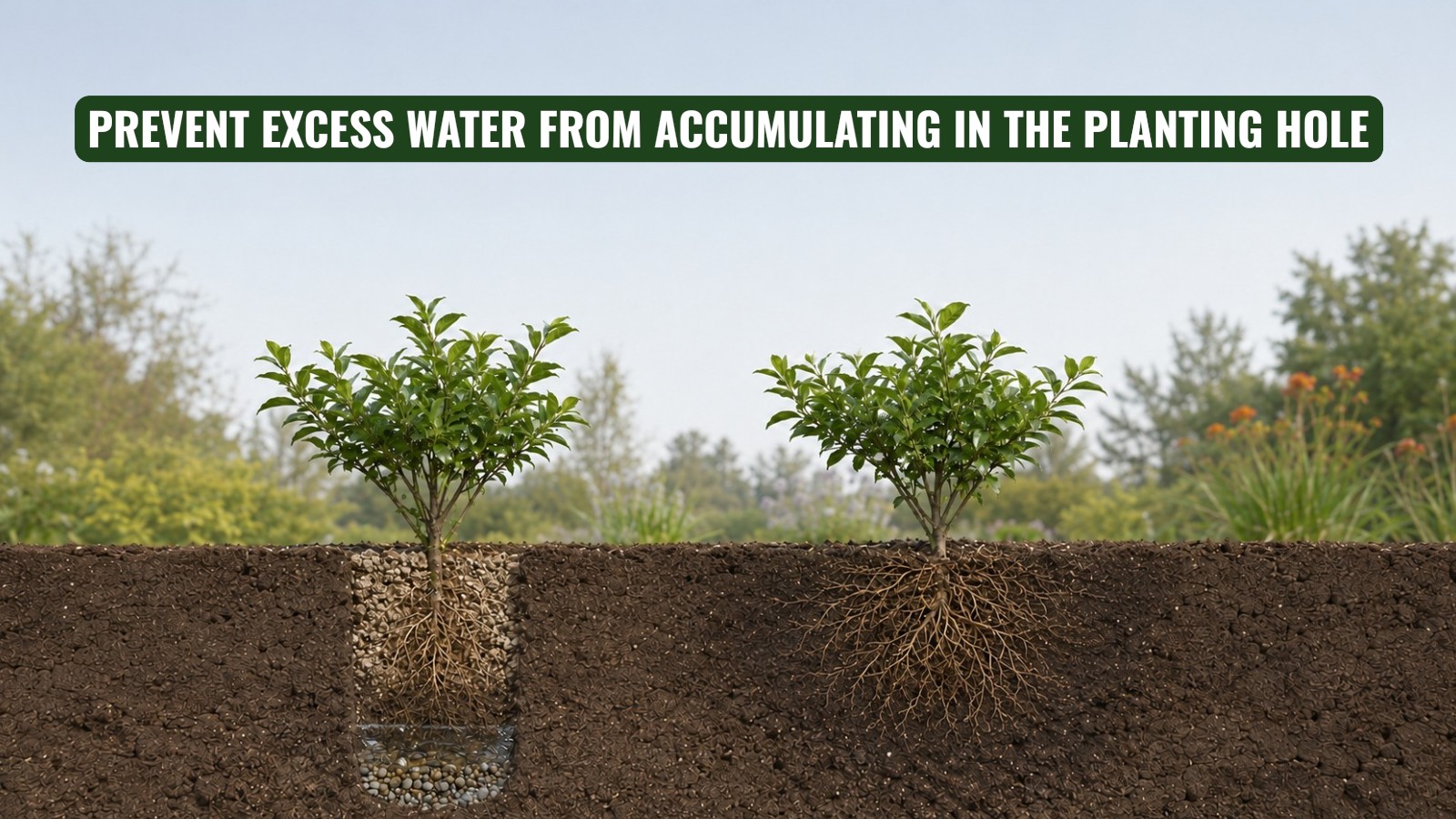
Do not automatically fill a planting hole with potting mix alone. If the amended section differs greatly from the surrounding soil, water may collect in the planting hole and roots may find it more difficult to grow beyond it.
How do you assess the existing substrate?
Does water penetrate the substrate evenly?
While watering, observe how the water spreads across the surface. In a properly functioning substrate, it penetrates reasonably evenly and does not remain on the surface for a prolonged period.
Water that immediately runs through cracks or down the sides of the pot may bypass parts of the root zone. This can happen when the substrate has shrunk, pulled away from the pot or become water-repellent in certain areas.
A severely dried-out or fine surface layer may initially absorb water more slowly. If this happens regularly or the water barely penetrates the substrate, check the overall structure and moisture distribution.
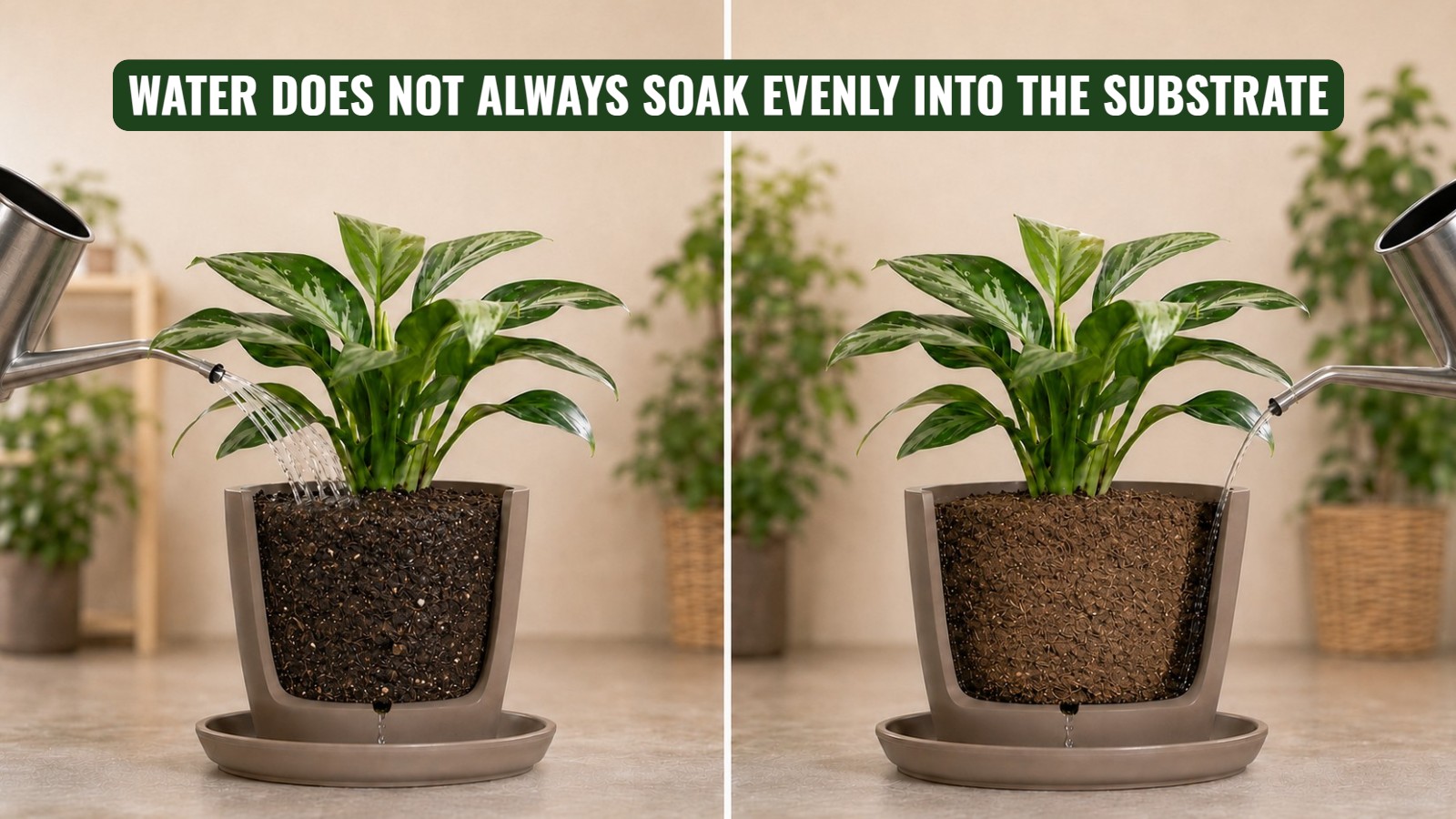
Does the substrate remain moist for neither too long nor too short a time?
Observe how long the substrate remains moist after watering. Take the plant, its location and the amount of substrate into account.
There is no fixed number of days in which every suitable mixture should dry out. A root environment that remains moist for a long time may be suitable for one plant, but may leave too little air around the roots of another.
This check allows you to assess whether the substrate remains moist for too long or too short a time in this situation. Determining the next watering time is covered on the Watering page.
Is water distributed throughout the entire root zone?
A moist surface does not mean that the water has also reached deeper parts of the substrate. Conversely, the surface may be dry while a large amount of moisture remains at the bottom of the pot.
Uneven distribution may be caused by differences in composition, compacted areas, cavities, cracks or channels through which water repeatedly drains away quickly.
Where possible without causing damage, check the moisture distribution at different depths and locations within the root zone.
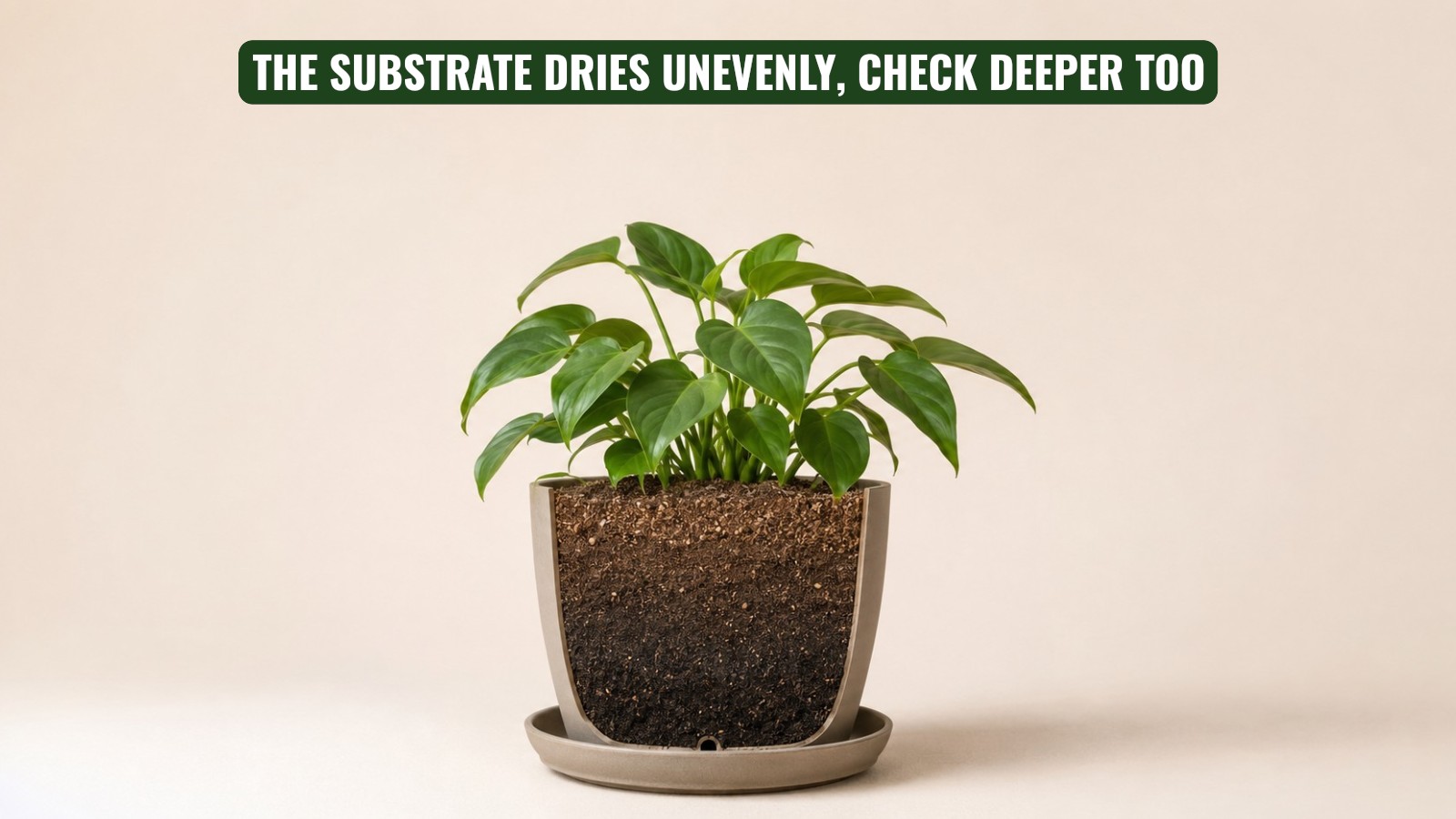
Is the structure still airy and stable?
Check whether the substrate has settled, become hard, pulled away from the sides of the pot or formed a dense surface layer.
When the substrate settles, this may indicate that organic components have broken down or that the particles have become more tightly packed. This changes the original structure and the amount of space between the particles.
Combine these observations with the way water penetrates, spreads and drains away. The condition of the surface layer alone does not provide a complete picture.
How can you adjust the properties of the substrate?
Components that retain more water
Coconut fibre, peat-based components and other organic materials can help the substrate retain more water. Certain fine mineral components can also retain water.
Coconut fibre can absorb moisture while contributing to an airy structure, although its properties differ between products. Peat-based materials retain a large amount of moisture, but after severe drying they may become more difficult to moisten evenly again.
Fine organic materials can retain water and nutrients. However, if their proportion is too high, they fill the spaces between coarser particles and increase the risk of compaction.
Components that improve aeration and drainage
Perlite, pumice, coarse bark and lava rock can contribute to more air space and better drainage. Their effect depends on their particle size, quantity, stability and distribution.
Perlite is light and porous, but may move upwards during use. Pumice and lava rock are heavier. The amount of water these materials retain and their porosity vary between types and sizes.
Coarse bark helps preserve larger pores, but gradually breaks down because it is an organic material. This makes the particles smaller and changes the structure.
An excessive proportion of coarse material may cause the substrate to retain insufficient moisture or distribute it unevenly. The performance of the mixture must therefore always be assessed as a whole.
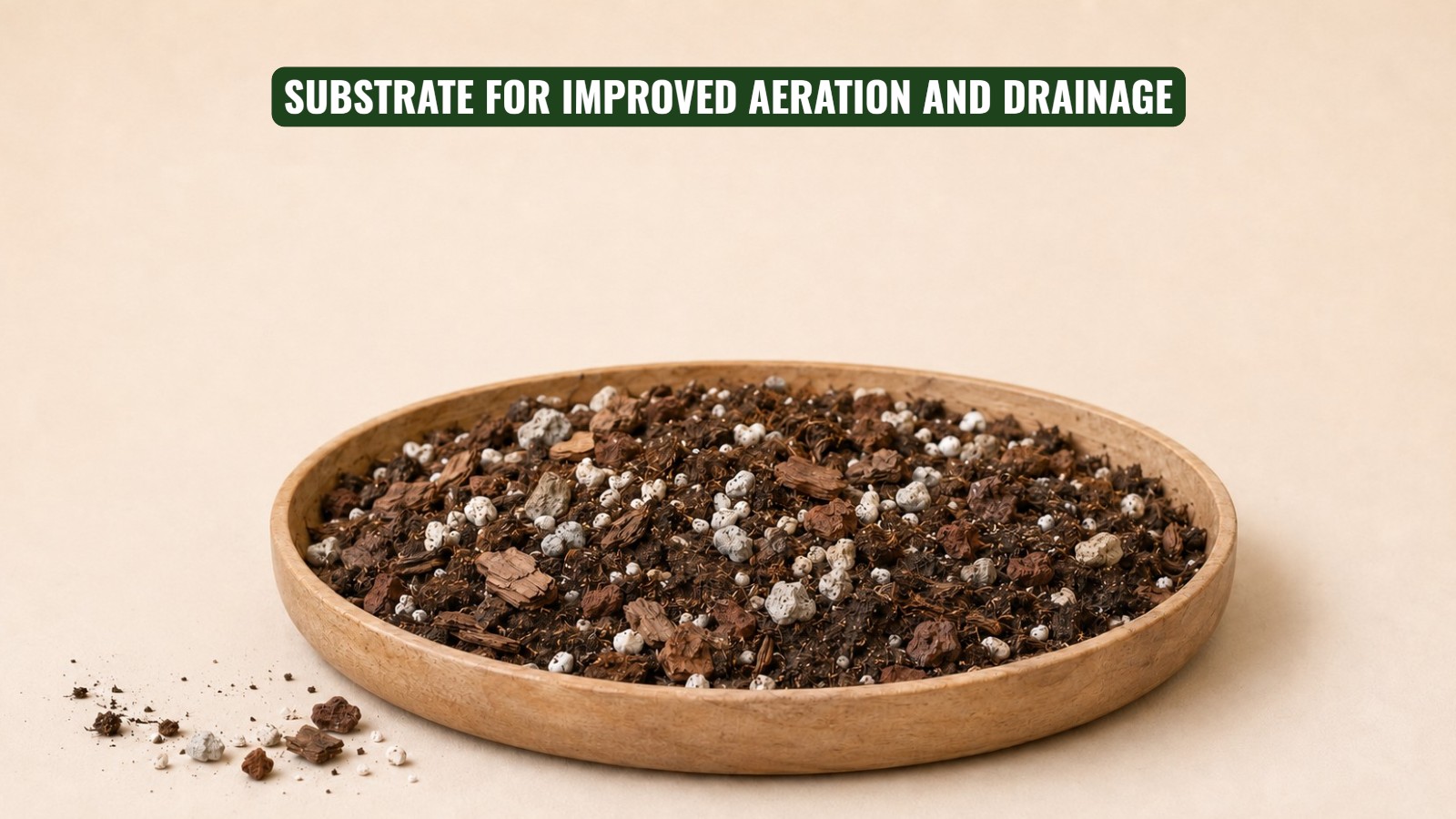
Why fine and coarse components need to be balanced
Fine components collectively have a large surface area and can therefore retain a relatively large amount of water. If their proportion is too high, they fill open spaces, causing the substrate to drain more slowly and leaving less air around the roots.
Coarse components support larger pores and the overall structure. However, a predominantly coarse mixture may retain too little water or direct water through only a few fast-flowing channels.
The suitable ratio differs between plants and situations. The result is largely determined by how the different particle sizes work together to create a structure that remains airy.
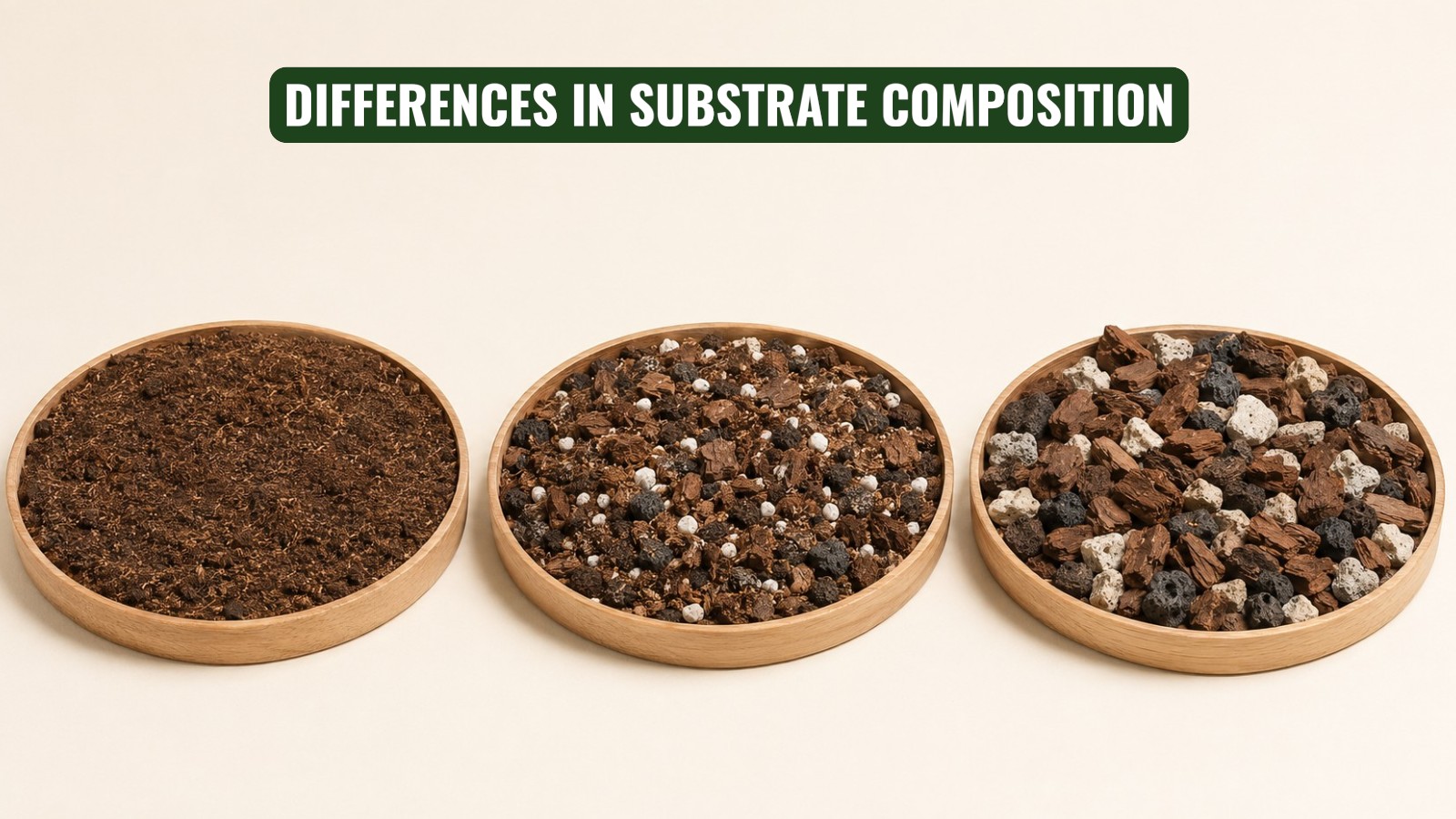
Why a single component or fixed recipe does not tell the whole story
A component often has several properties. It may retain water while also creating air space. In a different combination, the same material may fill pores or accelerate drainage too much.
A list of ingredients without proportions therefore says little about how the mixture will perform. The quality, particle size and stability of the materials are also important.
Use a fixed recipe only as a starting point. Then check whether the complete mixture suits the plant, its location, the climate and its use in a pot or in the open ground.
How do you ensure good drainage in a pot?
Ensure the drainage holes remain open
A pot must have enough drainage holes and they must remain completely open. Without unrestricted drainage, excess water remains at the bottom, even when the substrate is airy.
Check that the holes are not blocked by a flat surface, roots, compressed substrate or accumulated material. Mesh can prevent coarse substrate particles from falling out, but it must not obstruct the drainage of water.
A closed decorative pot has no drainage of its own. Preferably place a nursery pot with open drainage holes inside it and remove any drained water from the decorative pot.
Prevent the pot from standing in retained water
Water that briefly enters a saucer or decorative pot during watering does not immediately cause a problem. The risk arises when it remains there for a prolonged period and stays in contact with the bottom of the pot or the substrate.
After the pot has finished draining, check whether the excess water can be removed. Outdoors, also be aware of saucers and decorative pots in which rainwater may collect unnoticed.
Pot feet can keep drainage holes clear when a pot stands on a flat surface. This only works when the discharged water can then flow away freely.
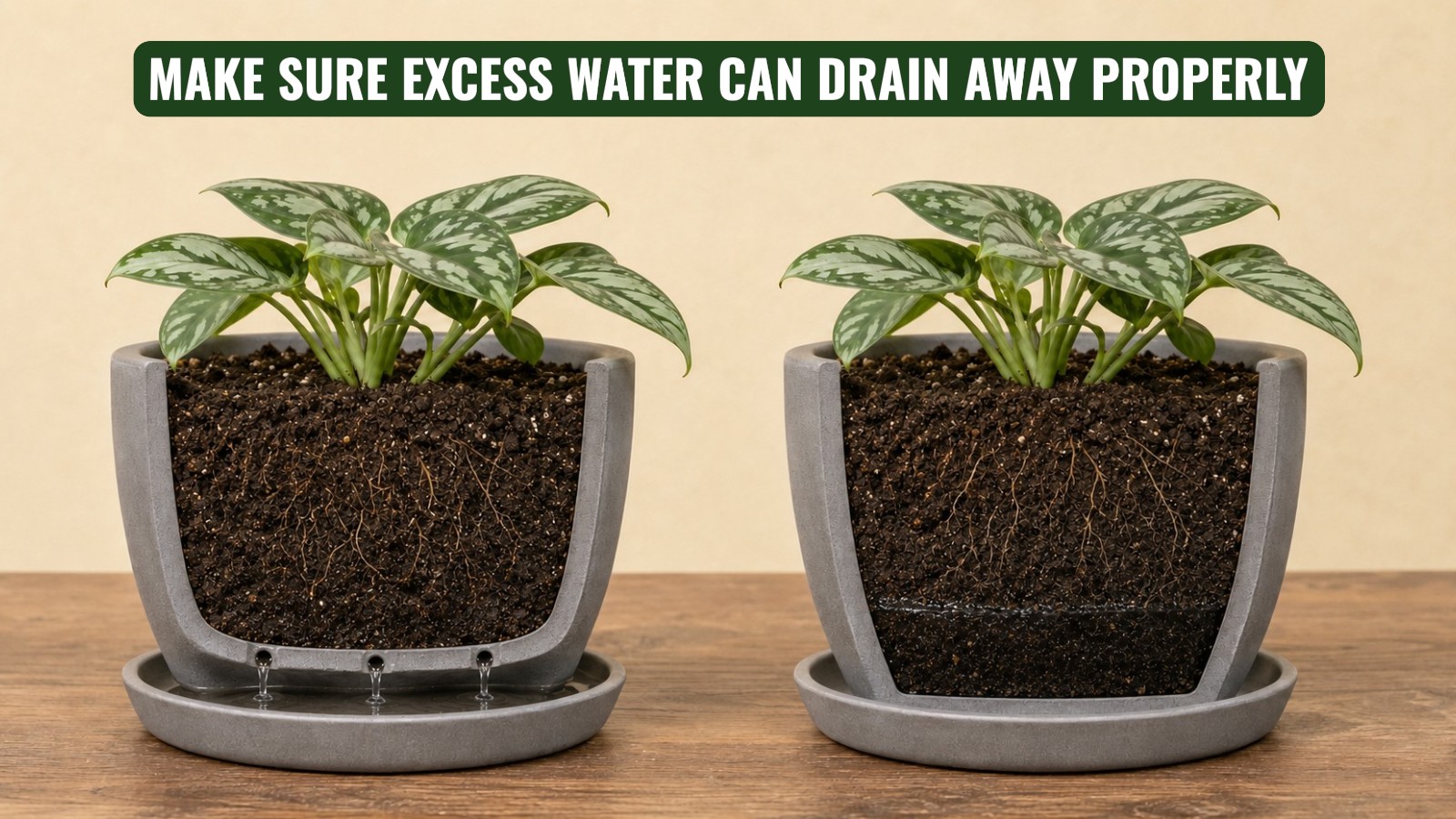
Take the volume of substrate into account
A large volume of substrate surrounding a small root ball can retain a considerable amount of water. Because the limited root system uses only part of this water, the surrounding mass often remains wet for longer.
The composition of the substrate, the drainage holes and the conditions also remain important. A large pot therefore does not automatically drain poorly.
Choosing the correct pot size and the repotting process are covered on the Repotting page. For drainage, the main consideration is that the amount of substrate influences the amount of moisture surrounding the roots.
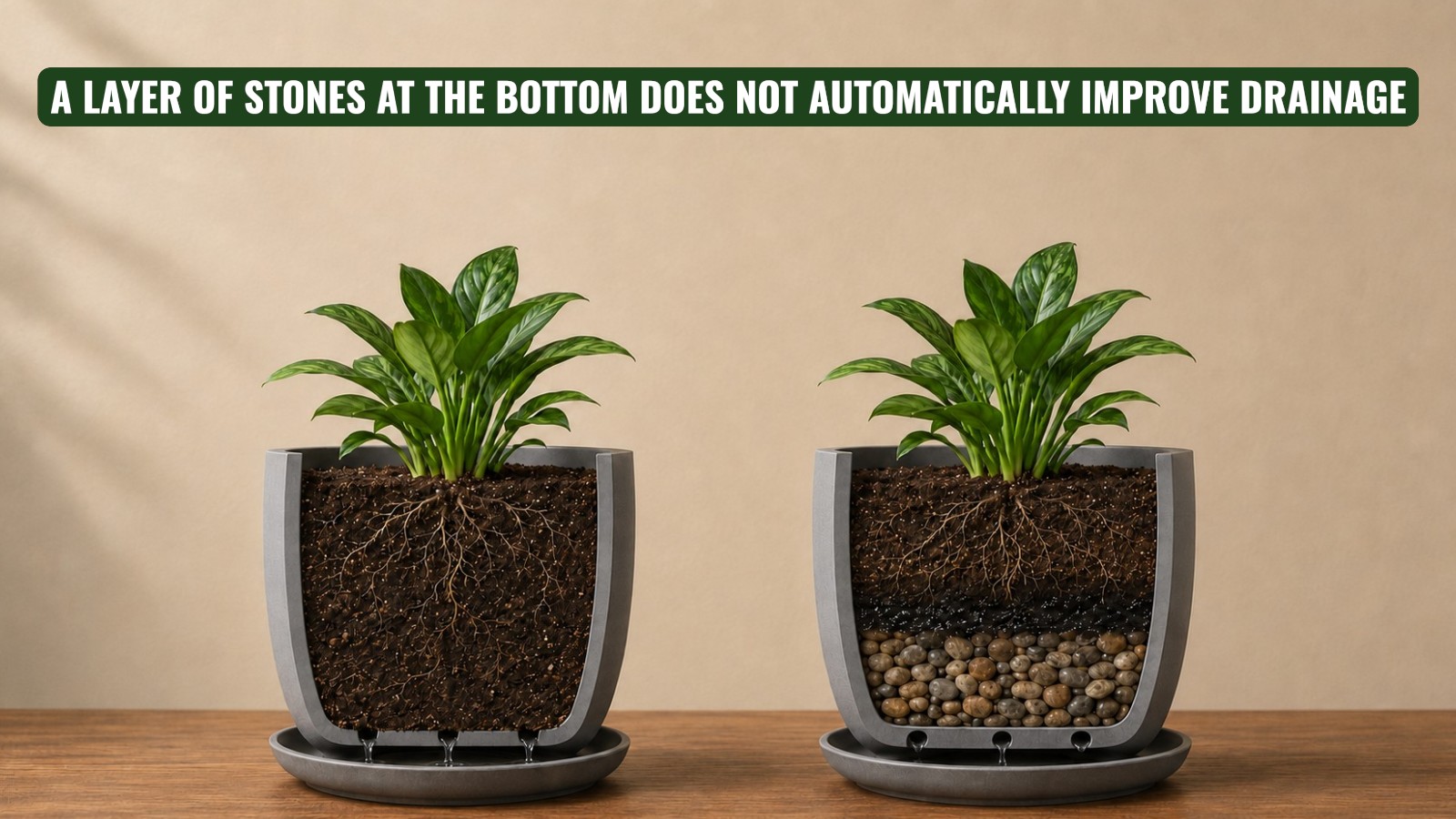
Why a layer of stones at the bottom of the pot does not automatically help
A layer of gravel, clay pebbles or stones beneath a finer substrate does not automatically cause water to leave the mixture above it more quickly. Water does not immediately move from fine pores into the much coarser spaces beneath them.
The substrate above may therefore remain saturated for longer before the water reaches the coarse layer. This layer also takes up space that could otherwise be filled with suitable substrate in which the roots can grow.
A layer of stones may be used for other purposes, but it does not improve the drainage of the substrate above it and cannot replace open drainage holes.
How do you ensure good drainage in the open ground?
Assess where water remains after rainfall or watering
Observe where water collects and how long it remains visible. Temporary surface water does not necessarily indicate a structural problem. Water that remains for a prolonged period may indicate that it is not penetrating the soil properly or is unable to drain into deeper layers.
Also consider the position of the planting site. Water may flow towards the root zone from paving, a slope or higher ground. A low-lying area may therefore collect more water than the soil can process.
A dry surface layer does not rule out the presence of a large amount of water deeper in the root zone.
Check the structure of the existing soil
Compacted soil contains fewer large pores, causing water to penetrate and drain more slowly. Compaction may be present at the surface or in a deeper layer.
Check whether the soil feels loose and crumbly or hard and dense. When digging a planting hole, also look for smeared sidewalls. These can form when wet clay soil is smoothed and compressed during digging.
Sandy, loamy and clay soils differ in structure and in the amount of water they retain. An adjustment that works for one soil type may have little effect on another or may even make its structure worse.
Prevent the planting hole from becoming a water reservoir
A planting hole filled with a very different, free-draining mixture can collect water in poorly permeable soil. Water moves quickly through the amended soil but cannot then escape into the surrounding area.
Ensure that the amended soil connects properly with the existing soil. Loosen smooth or compacted sidewalls and, if necessary, improve a larger area instead of only the planting hole.
A layer of gravel at the bottom does not solve a poorly permeable subsoil. If the water has nowhere to go, it will still remain around the roots.
Improve the root zone or plant in a raised area
When compaction or an unsuitable structure restricts drainage, the soil can be improved across a larger area. The approach must suit the soil type and the underlying cause.
Organic material can help improve the structure of certain soils. Randomly adding sand to heavy clay soil is not a reliable solution. If the wrong type of sand or an insufficient amount is used, the structure may not improve and the soil may actually become more difficult to work.
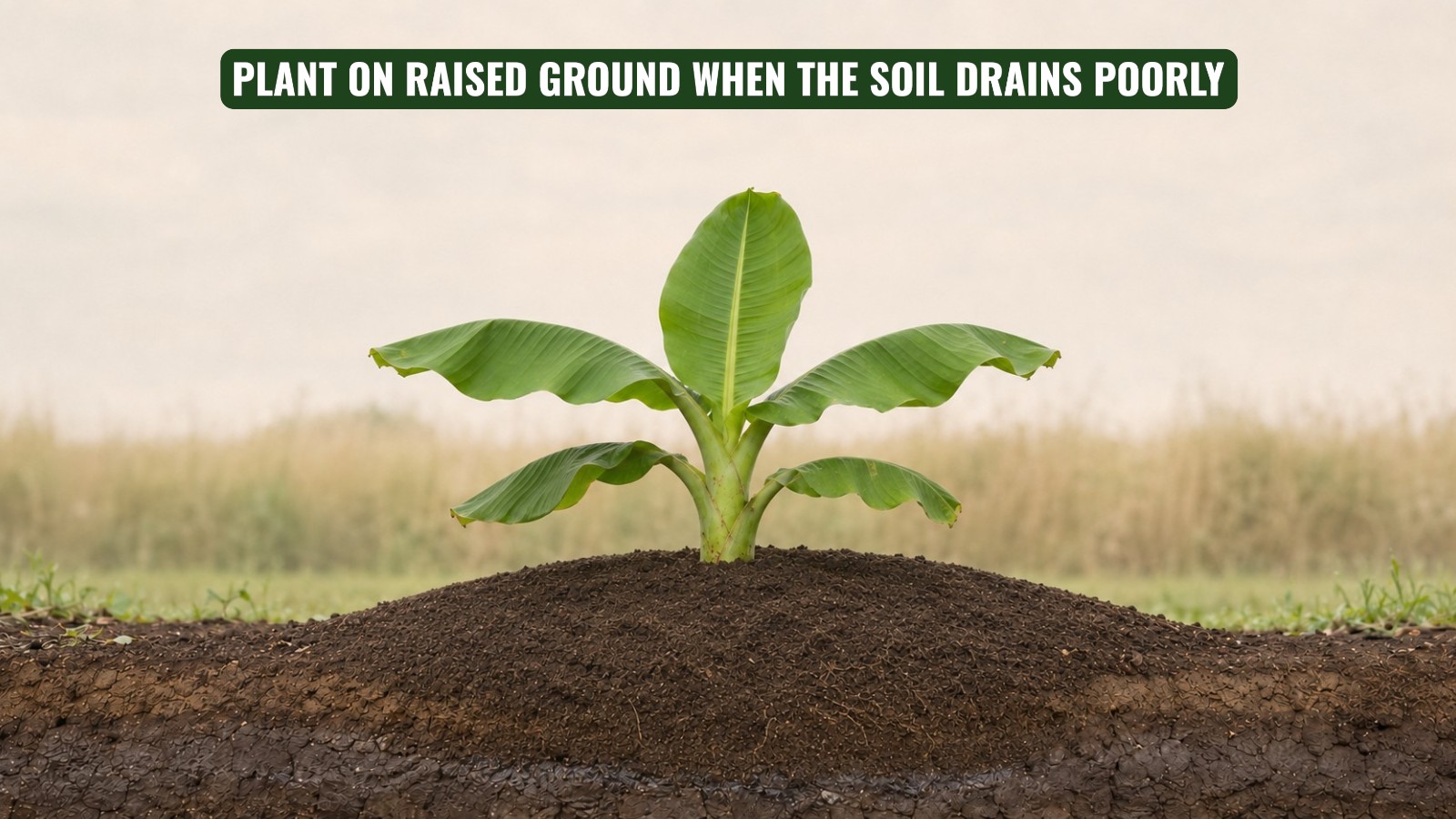
If drainage cannot be improved sufficiently at that location, planting on a mound or in a raised bed may provide a solution. A larger part of the root zone will then be positioned above the poorly permeable soil. The correct method depends on the plant, the soil profile and the local drainage conditions.
What signs indicate a poorly functioning substrate?
Water remains on the surface
Water that regularly remains on the surface for a long time may be related to a compacted top layer, a very fine structure or material that has difficulty absorbing water.
This does not automatically mean that the entire root zone is too wet. The water may eventually drain through a few specific channels. Therefore, also check the deeper structure and moisture distribution.
Water runs directly down the sides of the pot
When water immediately flows down the sides of the pot, the substrate may have shrunk or pulled away from the pot. The resulting gap then directs most of the water around the root zone.
Cracks, compacted areas and water-repellent patches can also create channels through which water drains quickly. Water flowing rapidly from the bottom of the pot therefore does not prove that the entire substrate has been sufficiently moistened.
The substrate remains noticeably wet for a long time
Substrate that remains wet for longer than is suitable for the plant and the conditions may retain too much water. Possible causes include a fine or compacted structure, blocked drainage holes, retained water or a large amount of substrate surrounding the roots.
Check the drainage, structure, moisture distribution and conditions before determining the cause.
Parts of the substrate dry out much faster
Large differences within the same root zone may be caused by an uneven composition. Some areas may contain more coarse material, while others contain more fine, moisture-retaining materials.
Cavities, cracks and localised compaction can also cause water to repeatedly follow the same route, leaving other parts of the substrate almost dry. Check whether the water reaches the entire root zone.
The substrate has settled or become hard or water-repellent
Settling may indicate that organic components have broken down or that the spaces between the substrate particles have been compressed. A hard mass can restrict the absorption, distribution and drainage of water.
Severely dried-out organic materials may have difficulty absorbing water again. The water then remains on the surface or drains through cracks.
Whether a local adjustment is still sufficient depends on the severity of the problem and the condition of the entire substrate.
How is substrate connected to other aspects of plant care?
The way the substrate performs is linked to watering, temperature, air movement and evaporation. The substrate also influences how many nutrients are retained, remain available to the plant or are washed out with the water.
Repotting can be a logical opportunity to reassess the composition and structure. Specific instructions for watering, temperature, humidity, nutrition and repotting are covered on the individual plant care pages.
What mistakes are commonly made?
Using the same standard mixture for every plant
A standard mixture may be suitable for several plants, but it does not suit every combination of plant and location.
Plants differ in their need for moisture, air space and drainage. The conditions also influence how the substrate performs. Therefore, consider the properties of the substrate rather than relying only on the name on the packaging.
Focusing only on rapid water drainage
Water flowing quickly out of a pot does not prove that the drainage is functioning properly. It may flow down the sides of the pot or through cracks without moistening the entire root zone.
A mixture that retains little water may also dry out too quickly or unevenly. Good drainage requires a balance between absorbing, distributing, retaining and draining water.
Using too much fine or too much coarse material
An excessive proportion of fine material can fill the spaces between larger particles. The substrate then compacts more easily, contains less air and drains more slowly.
Too much coarse material may cause the substrate to retain insufficient water and distribute moisture unevenly.
The correct ratio depends on all the materials used. The presence of a fine or coarse component alone therefore provides insufficient information.
Assessing only the surface of the substrate
The surface may dry out more quickly than the deeper root zone. Conversely, a dense surface layer may remain wet while water flows through cracks and past drier areas.
Where possible, also check the deeper structure and moisture distribution. Do not use the surface layer as the only measure of how the substrate is performing or when determining the next watering time.
Trying to correct a poor structure through watering
It may be temporarily necessary to adjust watering to the current situation. However, changing the watering method does not restore a compacted, degraded or structurally unsuitable substrate.
If water penetrates unevenly or remains in a dense root zone for a prolonged period, examine the structure and drainage. Changing only the amount or frequency of watering does not remove the underlying cause.
What can you check today?
- Check whether excess water can actually leave the pot or root zone.
- Observe whether water penetrates the substrate evenly.
- Check whether the substrate remains moist for neither too long nor too short a time.
- Assess the structure for compaction, settling and water repellency.
- For plants in the open ground, check where rainwater and irrigation water flow.
- Determine which property is not functioning properly and whether a targeted adjustment is possible.
- If the substrate of a potted plant is severely compacted, degraded or completely unsuitable, assess whether repotting it in a new and appropriate substrate is necessary.