Watering
Watering may seem simple, but it is one of the aspects of plant care where the most misunderstandings arise. Many plants receive either too little or too much water because decisions are based on assumptions or fixed routines. The right watering routine depends not only on the plant itself, but also on the current growing conditions.
On this page, you will learn how to determine when your plant needs water, how to water it correctly and how to adapt your watering routine to the current conditions. You will also discover why observing, checking and adjusting form the foundation of healthy watering, how to interpret your plant's signals more accurately and how to avoid common misconceptions.
How do you know when your plant needs water?
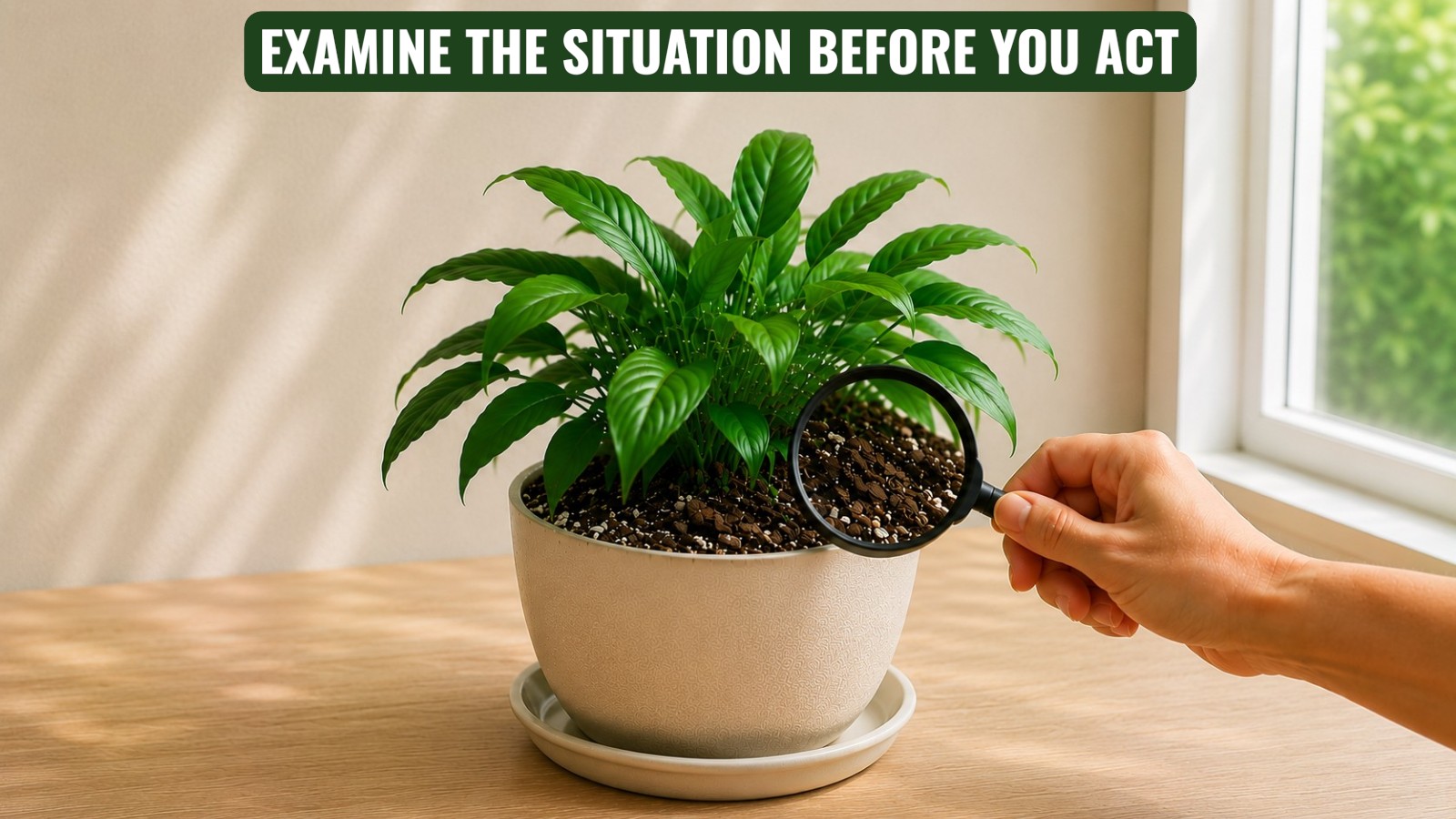
Proper watering does not begin with watering itself, but with correctly assessing the situation. Many plants are watered simply because it has become part of a routine or because the top layer of the potting soil feels dry. However, these first impressions do not always provide a complete picture of the plant's actual water requirements.
By checking the soil first, carefully observing your plant and replacing assumptions with observations, you will become better at recognising when water is genuinely needed. This allows every decision to be based on the current situation rather than on a fixed routine or a first impression. As a result, you avoid watering your plant when it does not yet need water or when it should already have been watered.
How do you check whether the soil is still moist?
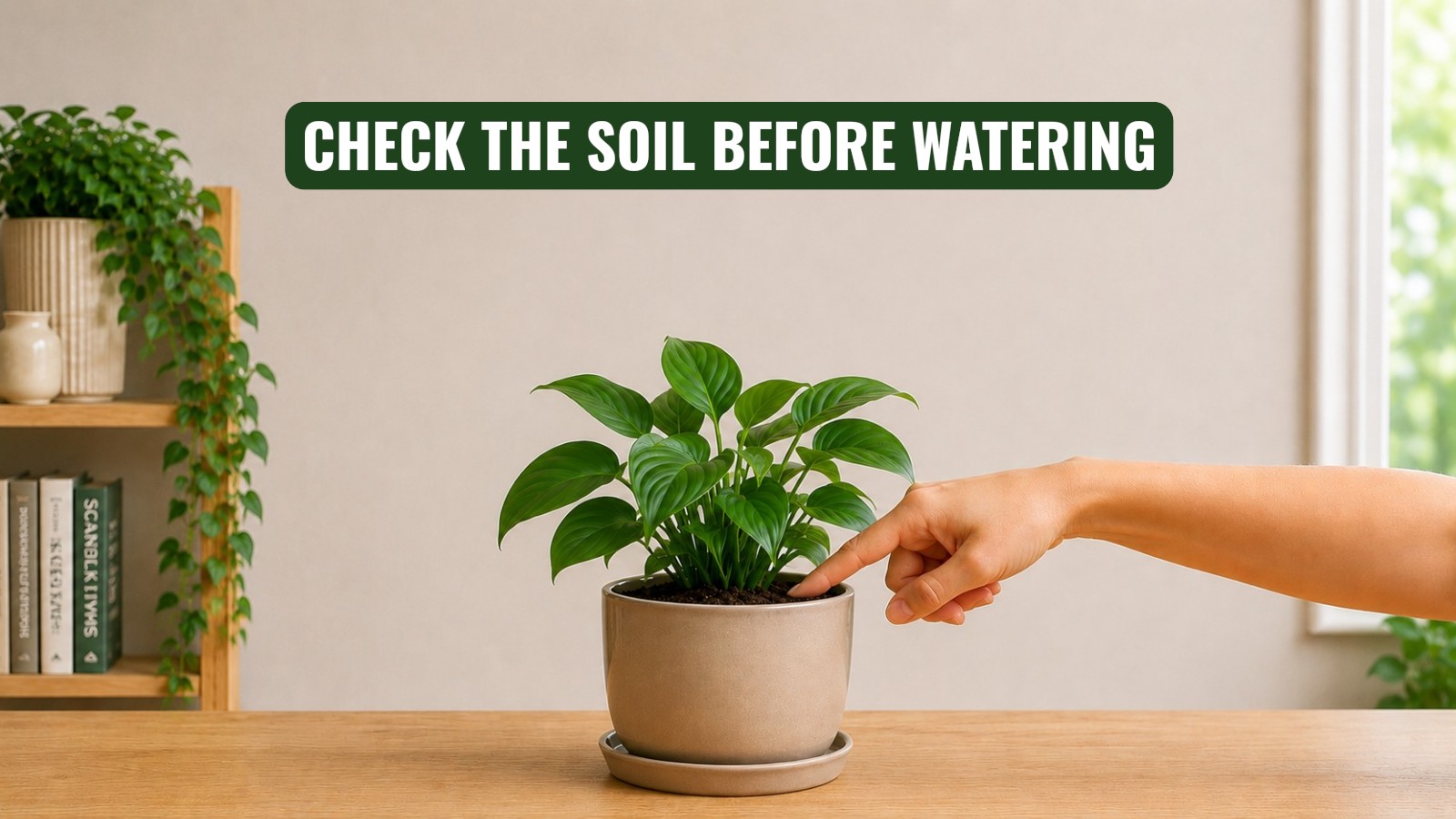
Checking the soil is one of the most reliable ways to determine whether a plant needs water. The top layer of the potting soil often dries out more quickly than the soil deeper inside the pot. As a result, the root ball may still contain sufficient moisture while the surface already feels dry.
Therefore, do not only check the top layer, but also the soil deeper inside the pot. You can do this, for example, by gently inserting your finger into the soil. If the soil still feels moist at that depth, watering is usually not necessary yet. If it feels sufficiently dry, this may indicate that the plant needs water. Always assess the situation together with your other observations.
Besides using your finger, there are other ways to check the soil moisture, such as using a moisture meter or judging the weight of the pot. No single method is completely reliable on its own. By combining several observations, you can make a more reliable assessment of whether your plant actually needs water at that moment.
Why a fixed watering schedule does not work
A fixed watering schedule may seem convenient, but in practice it rarely matches a plant's actual water requirements. The same plant may have different water requirements at different times. A schedule simply does not take the current situation into account.
It is therefore better to use a fixed schedule as a reminder to check your plant rather than as a fixed moment to water it. By assessing each time whether water is actually needed, your decision is based on the current situation rather than on a routine. This ensures that you only water your plant when it genuinely needs it at that moment.
Why looking only at the plant is not enough
Looking only at your plant is not enough to determine whether it needs water. Visible changes often appear only after the plant's water balance has already changed. If you wait until your plant shows visible changes, you are often already too late to make a reliable decision based solely on its appearance.
That is why it is important to always combine checking the soil with observing your plant. The soil often provides information about the current situation sooner, while the plant shows how it is responding. By combining both, you gain a more reliable understanding of your plant's current water requirements and can better determine whether it needs watering at that moment.
How do you water your plant correctly?
Determining that your plant needs water is only the first step. The way you water your plant also affects how well the moisture is absorbed by the root ball. Not only is the amount of water important, but also how you apply it and what you do afterwards.
By watering correctly, you help keep the root ball evenly moist and prevent common problems that can result from improper watering. In the following sections, you will learn where to apply the water, how much water is generally needed and what to do with any excess water.
Where and how should you water?
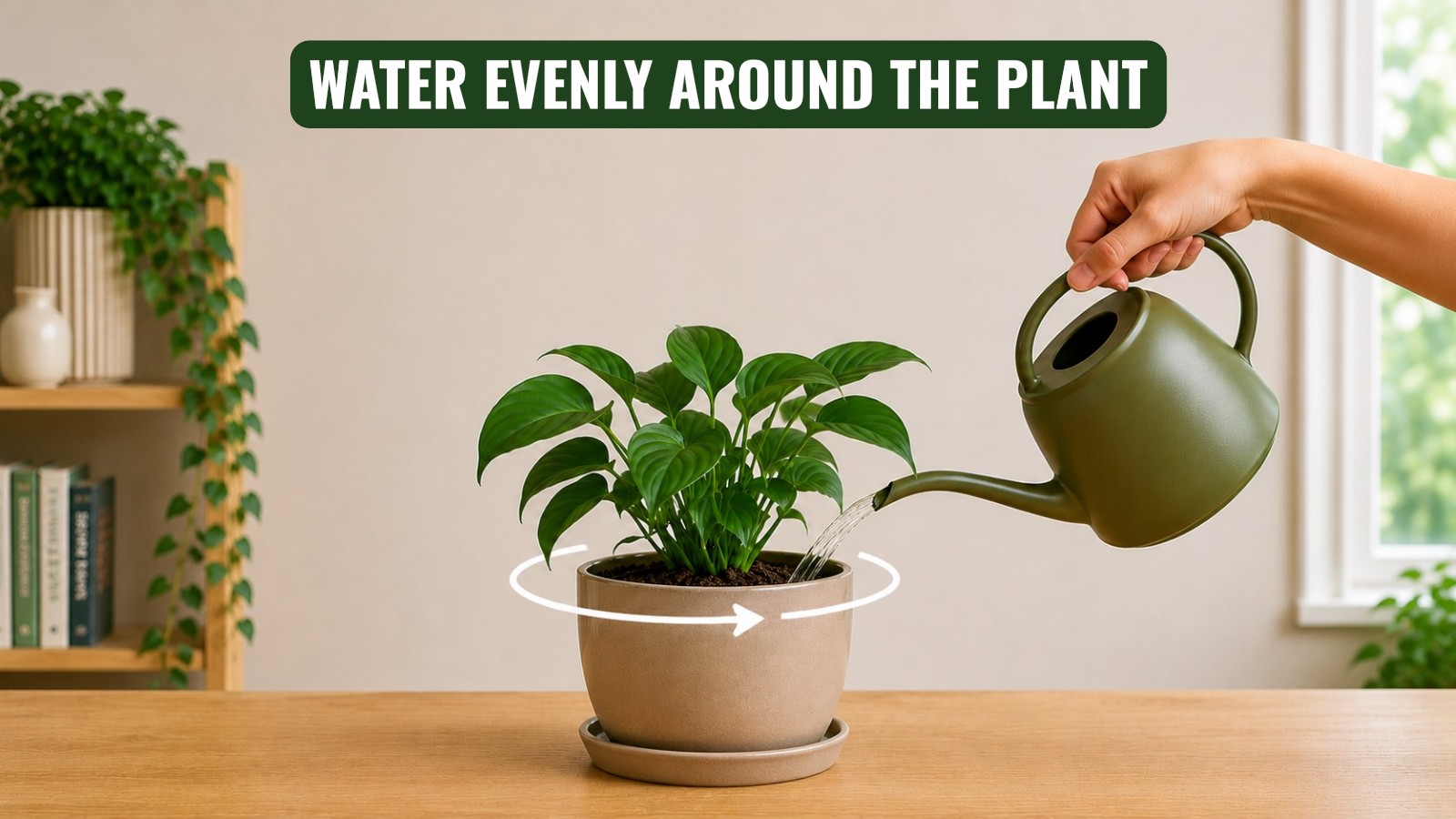
Not only the amount of water you give is important, but also the way you apply it. Pour the water slowly and evenly over the potting soil so it can spread properly throughout the soil and reach the entire root ball. If you pour water in only one spot or water too quickly, part of the potting soil may remain dry while another part becomes overly wet.
Therefore, aim to moisten the entire potting soil evenly instead of watering only one section. This helps distribute the moisture more evenly and allows the roots to absorb the water more effectively. The next section explains how much water your plant generally needs.
How much water should you give?
There is no fixed amount of water that is suitable for every plant. The goal is not to give a predetermined amount of water, but to moisten the entire root ball evenly. How much water is needed depends on several factors, including the plant, the pot size and the size of the root ball.
Therefore, give enough water to reach the entire root ball without focusing on a fixed amount. If only part of the root ball becomes moist, other parts remain dry and the plant will be less able to absorb the available water. Focus on achieving a completely and evenly moistened root ball rather than giving a fixed quantity of water.
What should you do with excess water?
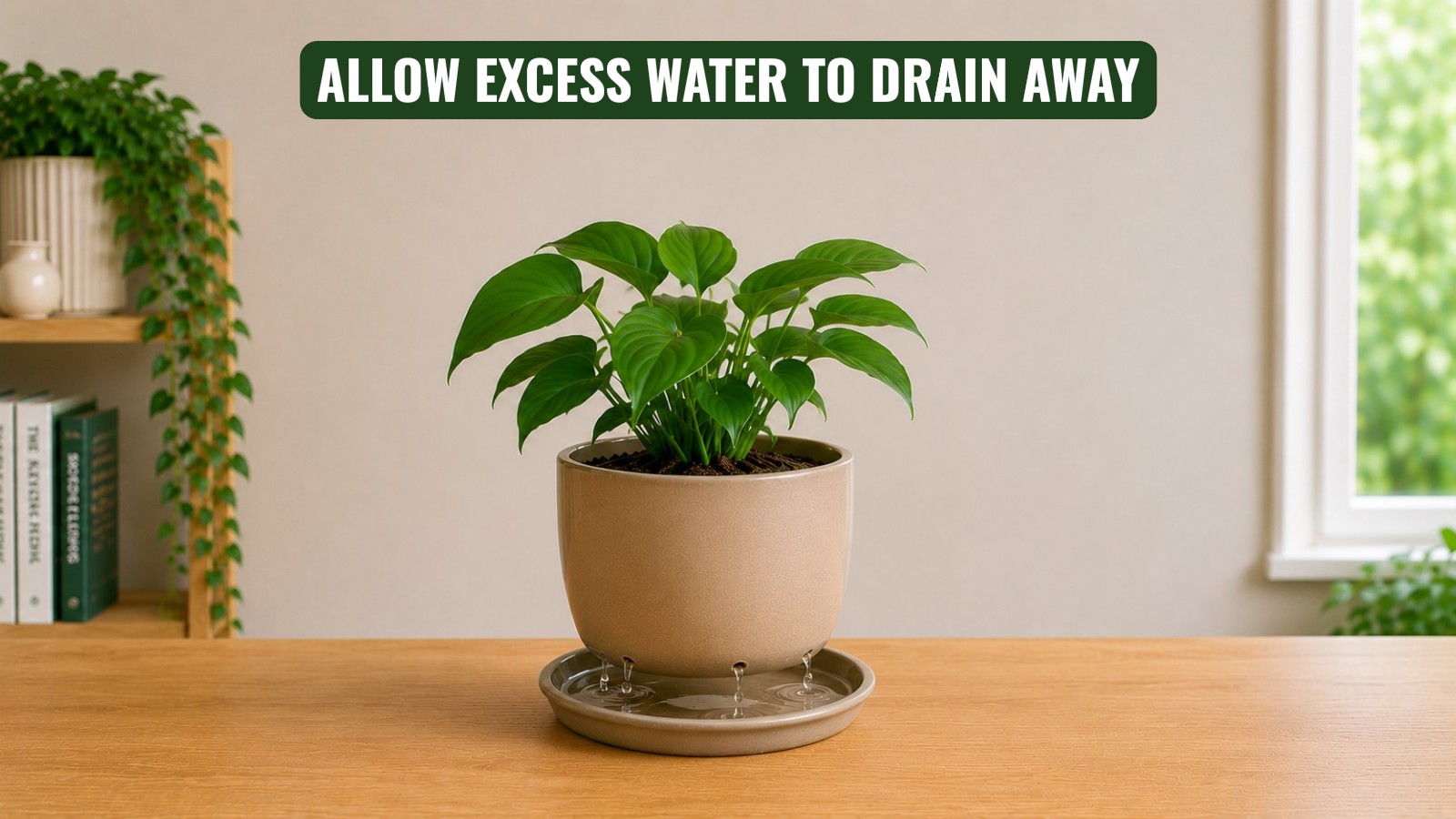
After watering your plant, it is important that any excess water can drain away properly. Water flowing out of the drainage holes may indicate that the water has reached the bottom of the pot. If excess water then remains in the pot or saucer for an extended period, the lower roots may stay unnecessarily wet.
Allow excess water to drain away after watering and remove it from the pot or saucer when necessary. This helps prevent the roots from standing in water for prolonged periods and supports a better moisture balance around the root system.
Learn more about the role of drainage and potting mix on the Substrate & Drainage page. Read more →
How do water and other plant care factors work together?
Watering never stands on its own. A plant's water requirements are constantly influenced by other aspects of plant care. When one care factor changes, the plant's water requirements often change as well. That is why it is important not to see watering as a separate task, but as part of the overall care of your plant.
A change in one care factor often means that your watering routine should also be reassessed. By adjusting your watering to the current conditions, it will better match what your plant needs at that particular moment. In the following sections, you will discover how different care factors influence watering.
Light and water
The amount of light a plant receives affects its water requirements. More light is often associated with a higher water demand, while less light usually results in a lower water demand. Therefore, when the amount of light changes, it is wise to reassess your watering routine.
The same plant may require different amounts of water depending on whether it receives more or less light. Adjust your watering to the current light conditions so it better matches what your plant needs at that moment.
Learn more about the role of light and placement on the Light & Location page. Read more →
Temperature and water
When the temperature changes, a plant's water requirements often change as well. As temperatures rise, water demand usually increases. As temperatures fall, water demand generally decreases. Therefore, when the temperature changes, it is wise to reassess your watering routine.
The same plant may require different amounts of water at different temperatures. Adjust your watering to the current conditions so it better matches what your plant needs at that moment.
Learn more about the role of temperature on the Temperature page. Read more →
Humidity and water
When the humidity changes, a plant's water requirements often change as well. Lower humidity is often associated with a higher water demand, while higher humidity usually results in a lower water demand. Therefore, when the humidity changes, it is wise to reassess your watering routine.
The same plant may require different amounts of water as the humidity changes. Adjust your watering to the current conditions so it better matches what your plant needs at that moment.
Learn more about the role of humidity on the Humidity page. Read more →
Potting mix & drainage
Changes to the potting mix or drainage can affect how much water a plant needs. The same plant may require a different watering routine when grown in a different potting mix or in a pot with different drainage. Therefore, when the potting mix or drainage changes, it is wise to reassess your watering routine.
Adjust your watering to the current conditions so it better matches what your plant needs at that moment.
Learn more about the role of potting mix and drainage on the Substrate & Drainage page. Read more →
Seasons and water
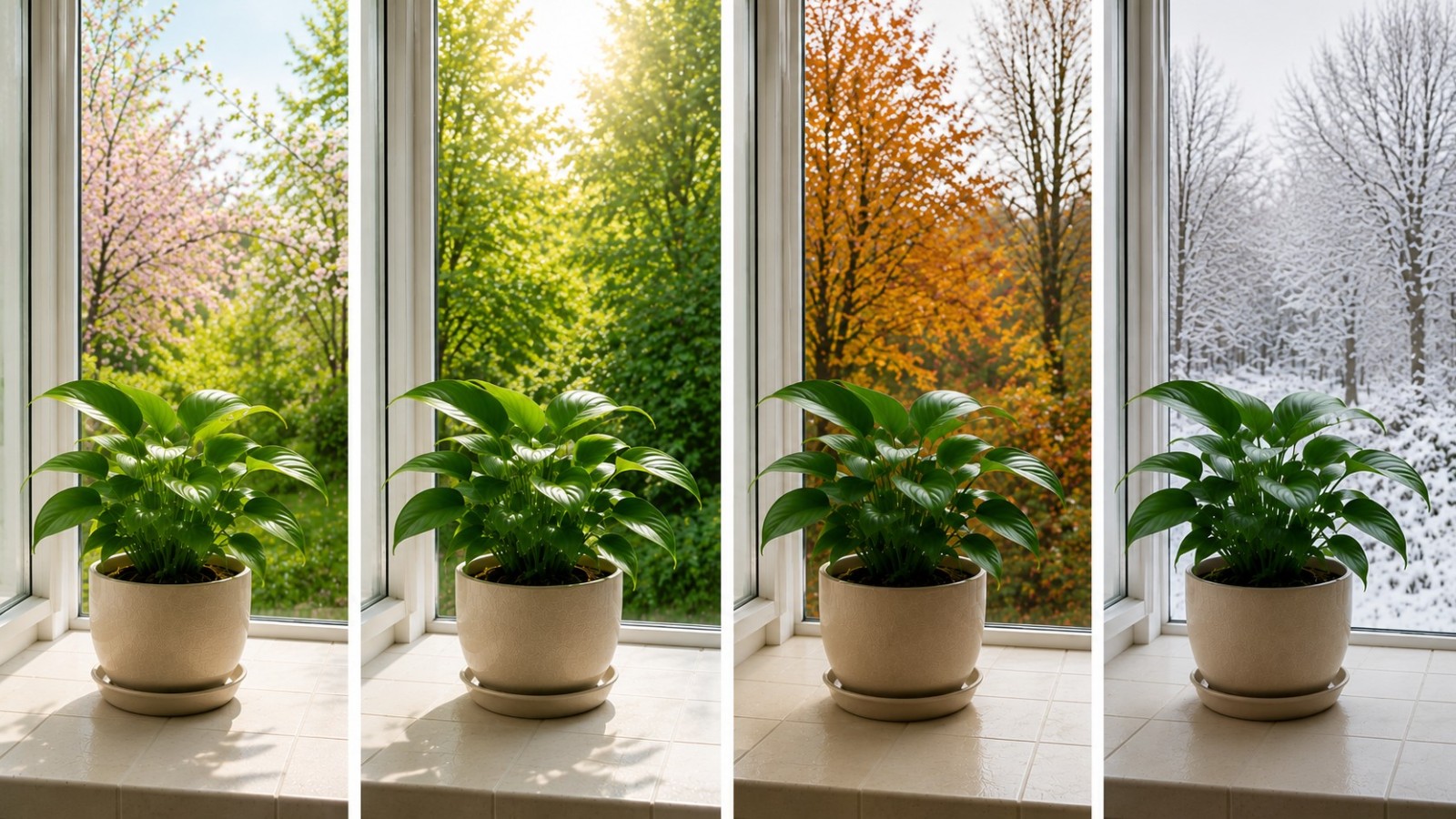
A plant's water requirements change throughout the year. The same plant often needs different amounts of water in spring, summer, autumn and winter. That is why it is important to reassess your watering routine regularly instead of using the same amount or frequency all year round.
Continue adjusting your watering to the current conditions and take seasonal changes into account. This helps ensure that your watering routine remains suited to what your plant needs at that particular time.
Would you like to learn more about caring for plants throughout the different seasons? Read more on the Seasonal Plant Care page. Read more → Coming soon
What is your plant trying to tell you?
Plants constantly give signals, but a single signal rarely tells the whole story. The same symptom can have different causes and should always be assessed carefully before drawing conclusions.
By combining your plant's signals with checking the soil and assessing the current conditions, you gain a more reliable understanding of what is really happening. This helps prevent you from identifying the wrong cause too quickly and allows you to judge whether the signals are related to your plant's water balance.
Signs that may indicate too little water
When a plant shows visible changes, these may indicate that it is not receiving enough water. Leaves may start to droop, lose their firmness or become drier. Growth may also slow down. These signs can point to underwatering, but on their own they do not reveal the actual cause.
Always assess these signals together with the condition of the soil and your other observations. Only when several observations point in the same direction can you build a more reliable picture of the current situation.
Would you like to learn more about the effects of underwatering? Read more on the Too Little Water page. Read more → Coming soon
Signs that may indicate too much water
When a plant shows visible changes, these may indicate that it has received too much water. Leaves may start to droop, change colour or lose their firmness. Growth may also slow down. These signs can point to overwatering, but on their own they do not reveal the actual cause.
Always assess these signals together with checking the soil and your other observations. Only when several observations point in the same direction can you build a more reliable understanding of the care your plant needs.
Would you like to learn more about the effects of overwatering? Read more on the Too Much Water page. Read more → Coming soon
Why can the same symptoms have different causes?
A single symptom rarely tells the whole story. The same visible sign can have several different causes and does not automatically mean that your plant has received too much or too little water. If you rely on just one visible symptom, there is a good chance that you will draw the wrong conclusion.
A reliable assessment is made by combining multiple observations and always considering them together with the condition of the soil and your other observations. This provides a more complete understanding of the care your plant needs and helps prevent you from trying to solve a problem that may actually have a different cause.
What are the most common misconceptions?
Many watering problems do not arise because plant care is complicated, but because incorrect conclusions are drawn. Incorrect conclusions often lead to incorrect actions. For example, a fixed routine or a false assumption may cause a plant to be watered when it does not actually need it.
By recognising these common misconceptions, you will learn to look at your plant's care differently. This helps you avoid making decisions based on false assumptions and enables you to adjust your watering routine more accurately to what your plant really needs.
Watering according to a fixed schedule
A fixed watering schedule may seem organised, but it is often based on the assumption that a plant always needs the same amount of water. In practice, a fixed schedule regularly fails to match a plant's actual water requirements. As a result, a plant may be watered when it does not yet need water or only after it has already needed it.
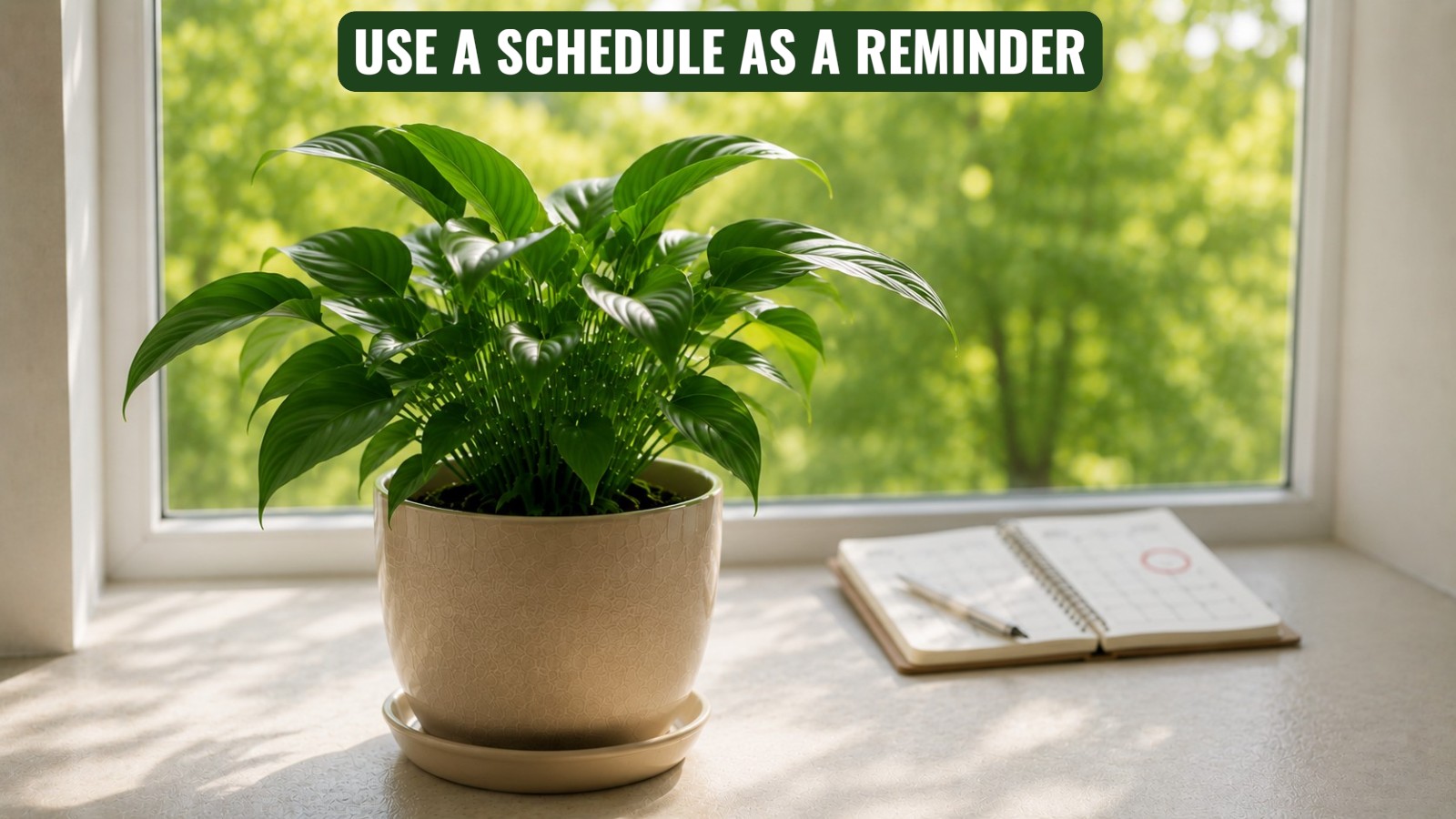
Instead, use a fixed schedule as a reminder to check your plant rather than as a fixed time to water it. By observing your plant and reassessing the situation each time, your decision is based on what your plant actually needs instead of on a fixed routine.
Watering without checking the soil
Many people assume that their plant needs water without checking the soil first. When you base your decision on an assumption instead of checking the soil, there is a risk that you will water your plant when it does not yet need it. A dry top layer or a fixed routine is not a reliable basis for deciding whether to water.
Always check the soil before deciding to water your plant. By basing your decision on the condition of the soil rather than on an assumption, you avoid watering your plant unnecessarily or waiting too long before watering.
Giving too much or too little water
Overwatering and underwatering often result from decisions based on incorrect assumptions rather than on a reliable assessment. Giving more water is not automatically better, and giving less water is not automatically better either. The right decision starts with carefully assessing what your plant needs at that particular moment.
Instead of focusing on giving as much or as little water as possible, focus on making a well-informed decision. By observing your plant, checking the soil and carefully assessing the situation first, you avoid giving too much or too little water based on incorrect assumptions.
Leaving water in the pot or saucer
Water that remains in a pot or saucer after watering is often overlooked. However, it is a misconception to think that standing water has no effect on your plant's care. Remove excess water after it has had enough time to drain away and do not allow it to remain unnecessarily in the pot or saucer.
Always check after watering whether any water has collected in the pot or saucer. By making this part of your regular watering routine, you can prevent a common misconception from becoming part of your plant care.
Learn more about the role of drainage and potting mix on the Substrate & Drainage page. Read more →
Not taking changing conditions into account
A common misconception is that the same watering routine will always work. As conditions change over time, a routine that once worked well may gradually become less suitable for your plant's actual needs.
Continue reassessing your watering routine regularly instead of relying on previous experience alone. By adjusting your decisions to what you currently observe, you prevent a fixed routine from becoming more important than what your plant actually needs at that moment.
Why does watering change throughout the year?
Your watering routine changes together with your plant's natural growth cycle, not according to a fixed calendar. Throughout the year, a plant's water requirements change, which means the same watering routine will not always match what your plant needs.
Continue reassessing your watering routine regularly and adjust it to your plant's current needs. This helps your care stay in line with your plant's natural rhythm and prevents a fixed routine from becoming more important than its actual water requirements.
Spring
During spring, the water requirements of many plants gradually begin to increase. This change usually happens step by step. That is why it is important to reassess your watering routine regularly instead of changing it all at once.
Continue adjusting your watering to what your plant needs at that particular moment. This helps your watering routine stay aligned with your plant's natural growth cycle rather than following a fixed calendar.
Summer
During summer, the water requirements of many plants are generally higher than during other times of the year. That is why it is important to reassess your watering routine more frequently instead of automatically following the same routine.
Continue adjusting your watering to what your plant needs at that particular moment. By regularly checking whether water is actually needed, you prevent a fixed routine from becoming more important than your plant's current requirements.
Autumn
During autumn, the water requirements of many plants usually begin to decrease gradually. That is why it is important to reassess your watering routine instead of automatically continuing with the same schedule.
Continue adjusting your watering to what your plant needs at that particular moment. By regularly checking whether water is actually needed, you prevent a fixed routine from becoming more important than your plant's actual requirements.
Winter
During winter, the water requirements of many plants are generally lower. At this time of year, it is common to assume that a plant needs the same amount of water as it did earlier in the year. That is why it is important to reassess your watering routine instead of automatically continuing with the same schedule.
Continue adjusting your watering to what your plant needs at that particular moment. By regularly checking whether water is actually needed, you avoid giving unnecessary amounts of water and ensure that your watering routine remains suited to your plant's needs.
Would you like to learn more about caring for plants throughout the year? Read more on the Seasonal Plant Care page. Read more → Coming soon
What can you do today?
Good plant care does not begin with giving more water, but with observing, checking and adjusting more effectively. By applying these habits every time you water your plant, you can avoid many of the most common mistakes and learn to adapt your watering routine more accurately to what your plant needs.
The following sections are not separate tips, but practical habits that you can apply every time you water your plant. This allows you to put the most important insights from this page directly into practice during your daily plant care.
Check the soil before every watering
Always check the soil before watering your plant. By first determining whether water is actually needed, you avoid making decisions based on a fixed routine or a first impression.
A quick check only takes a moment, but it helps you make better decisions. Over time, checking the soil becomes a simple habit that naturally becomes part of every watering routine.
Observe how your plant responds
Observe how your plant responds. By taking a moment to look at your plant regularly, small changes often become noticeable sooner. This helps you better understand how your plant is developing and whether your current care routine still matches its needs.
Do not base your conclusions on a single observation. Instead, look at the overall picture. By following changes over a longer period and combining different observations, you can make more reliable decisions and better adapt your care to what your plant needs at that moment.
Adjust your watering to the conditions
Always adjust your watering routine to what your plant needs at that particular moment. A fixed routine can serve as a useful starting point, but it should never become the deciding factor. By reassessing your watering regularly, it will continue to match your plant's current needs.
Continue observing, checking and adjusting whenever the situation changes. This turns flexible plant care into a natural habit and helps you apply the most important lessons from this page in your everyday care routine.
Frequently Asked Questions
Can I water my exotic plant with tap water?
Yes, in most cases you can safely water your exotic plant with tap water. However, the quality of tap water varies from one region to another, which means it may be less suitable for certain plants.
If you are unsure whether tap water is suitable for your plant, rainwater or filtered water can be a good alternative in some situations. For most exotic plants, however, tap water is perfectly suitable.
Is rainwater better than tap water?
For many exotic plants, rainwater is a suitable alternative to tap water. It often has a different composition than tap water. Whether rainwater is actually better depends on the quality of the collected rainwater and the specific needs of the plant.
If clean rainwater is not available, tap water is also perfectly suitable for most exotic plants.
Is it better to water my plant in the morning or in the evening?
For many plants, watering in the morning is generally preferred. If that is not possible, watering at another time of the day is usually not a problem.
More important than the exact time is checking whether your plant actually needs water first. Then adjust your watering to what your plant needs at that particular moment.
What should I do if I forget to water my plant?
Forgetting to water your plant once does not necessarily cause a problem. Do not automatically give your plant extra water to make up for it. First check the soil and determine whether your plant actually needs water.
If your inspection shows that your plant needs water, simply water it as you normally would. This helps prevent a single oversight from creating a new problem.
How long can an exotic plant survive without water?
There is no fixed period that applies to every exotic plant. How long a plant can go without water depends on both the plant itself and the current growing conditions.
Do not assume that your plant can go without water for a specific number of days. Instead, check the soil first and assess the situation before deciding whether to water.
Should I give my plant extra water before going on holiday?
No, do not automatically give your plant extra water before leaving for a holiday. Giving more water than your plant needs can actually cause problems. Before you leave, first check the soil and determine whether your plant actually needs water.
If your inspection shows that your plant needs water, water it as you normally would. Do not automatically assume that extra water is needed simply because you will be away for a while.