Repotting
Repotting involves more than placing an exotic plant in a larger pot. First, you determine whether the plant truly needs more root space. The pot size, planting depth and the way you handle the root ball then determine whether the plant is transferred properly and remains stable.
Not every exotic plant grows at the same rate or tolerates the same degree of root disturbance. Various palms and other root-sensitive plants benefit from having their healthy roots disturbed as little as possible. Therefore, always assess the plant, the pot and the root ball as a whole.
On this page, you will learn when repotting is necessary, how to choose a suitable pot, how to prepare the plant and how to transfer it safely step by step. The composition of the substrate and the technical construction of the drainage system are covered under Substrate & drainage.
Why is sufficient root space important?
Roots spread through the available space in the pot, absorb water and nutrients and anchor the plant. As the plant grows, an increasing proportion of the pot becomes filled with roots. As long as the root ball still has sufficient room to develop, a larger pot is not automatically necessary.
When space remains limited for a prolonged period, roots can begin circling closely along the inside of the pot. Eventually, little visible substrate and little free space may remain between the roots. Further growth may then be restricted. A large or top-heavy plant may also become less stable when the pot is no longer proportionate to the plant.
A fully rooted pot does not immediately mean that the plant is unhealthy. Some species naturally form a compact root ball. The amount of space required depends on factors including the species, growth rate, size of the plant and the conditions in which it is kept.
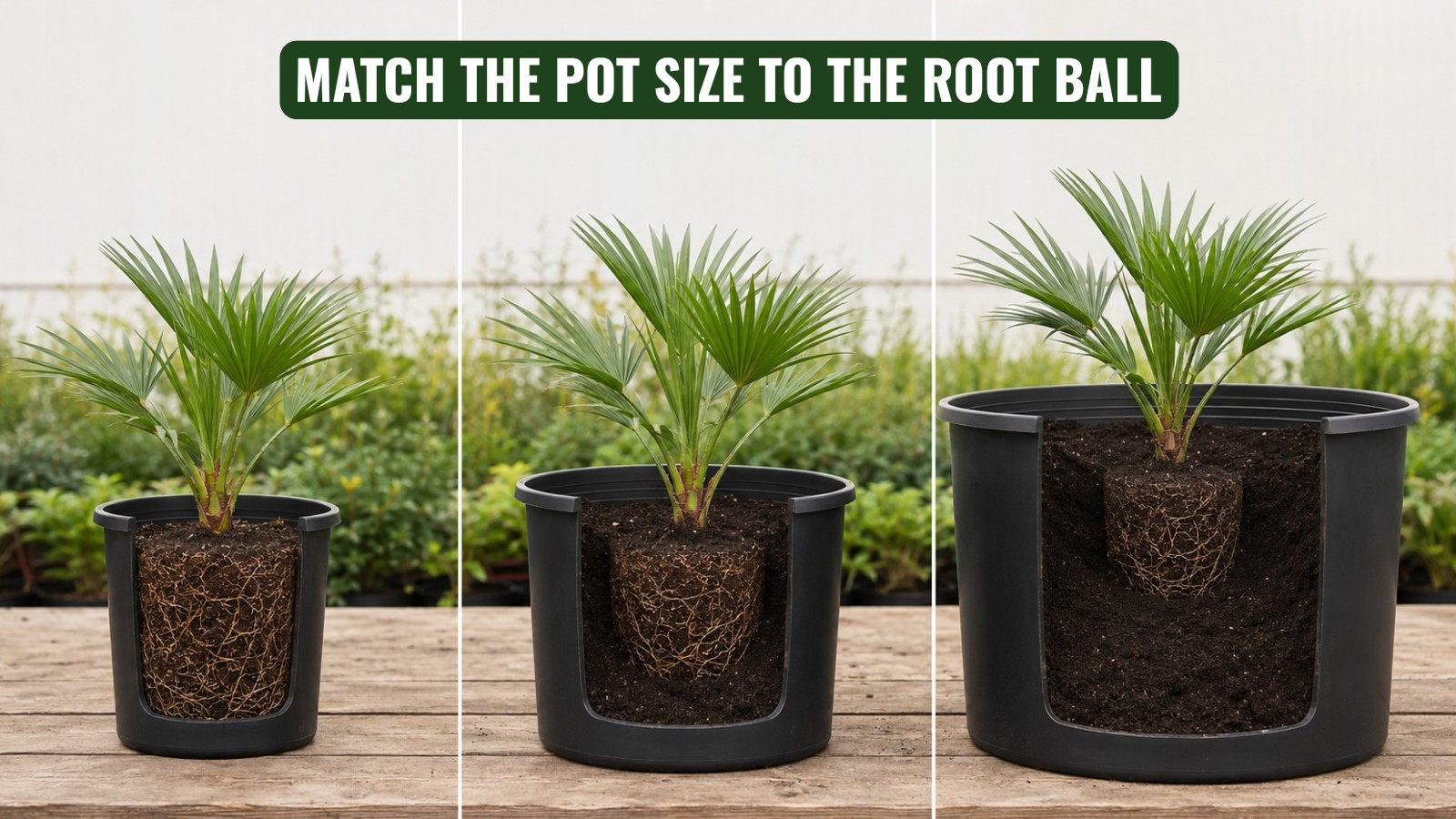
An unnecessarily large pot is not ideal either. A considerable amount of new substrate then remains around a small root ball. This substrate is only sparsely rooted, making it more difficult to determine how much water the plant actually needs. The aim is therefore not to provide as much space as possible, but to choose a suitable next pot size.
When is it time to repot an exotic plant?
Exotic plants do not need to be repotted according to a fixed annual schedule. The root ball, growth and proportion between the plant and pot determine whether repotting is necessary.
Which signs may indicate insufficient root space?
A combination of the following signs may indicate that the current pot provides too little space:
- the root ball fills almost the entire pot
- many roots circle closely along the inside of the pot
- large numbers of roots grow through the drainage holes
- the pot becomes distorted or cracks due to pressure from the roots
- the plant has become top-heavy and is no longer stable
- growth slows down even though the light, temperature, watering and nutrition are appropriate
- the pot has clearly become too small in proportion to the plant and root ball
A single sign is not always sufficient. One root growing through a drainage hole, for example, does not mean that the plant must be repotted immediately. Instability can also be caused by a pot that is too light or has an unsuitable shape, even when sufficient root space remains. Therefore, always assess the entire situation.
How do you determine whether repotting is truly necessary?
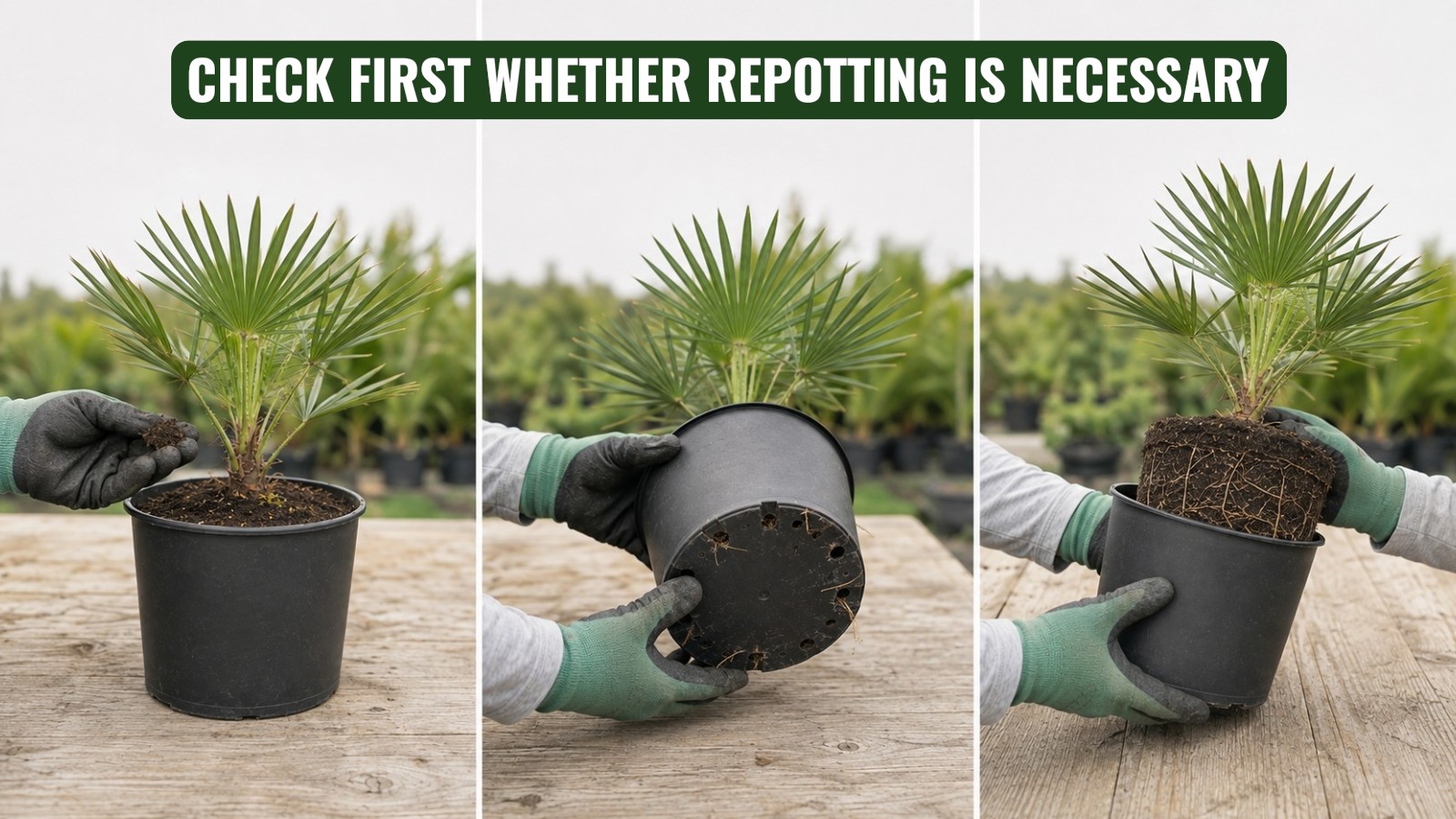
When the plant can be safely removed from the pot, the outside of the root ball provides the clearest information. Support the plant and root ball, carefully tilt the pot and do not pull on the trunk, leaves or growing point. With a flexible nursery pot, gently press the sides of the pot to release the root ball.
Check how many roots are visible and how much substrate can still be seen. Look for roots growing densely and repeatedly in circles, whether the root ball has completely assumed the shape of the pot and whether space for further growth remains. A firm root ball with visible roots may still have sufficient space. A very dense root ball with hardly any visible substrate is more likely to indicate insufficient space.
If you see soft, dark, severely discoloured or unpleasant-smelling roots, there may be another issue besides insufficient space. In that case, consult the Root rot and Root suffocation guides before loosening or removing healthy roots.
What is a suitable time to repot?
Planned repotting should preferably take place while the plant is actively growing and can adapt to the new pot. Extreme heat, cold and periods of minimal active growth are generally less suitable. The best time varies depending on the plant species and situation.
A cracked pot, serious instability or a severe lack of space may require earlier action. In that case, resolving the immediate problem is more important than waiting for the ideal moment. If the current pot is still sturdy and the root ball has sufficient space, avoid unnecessary repotting.
Which pot and pot size should you choose?
A suitable pot supports both the root ball and the above-ground part of the plant. Appearance may play a role, but the pot must primarily be sturdy, stable and appropriately sized.
Which functional requirements must the pot meet?
The new pot must be wide and deep enough to position the root ball at the correct height. There must be room for further root growth without placing the root ball in an excessively large volume of substrate. When planting directly into the pot, the drainage holes must remain clear so excess water can drain away.
Also consider the total weight and shape. A tall or top-heavy plant requires a sturdy base that does not tip over easily. A pot that narrows considerably towards the top can make it difficult to remove a wide root ball without damaging it during a future repotting.
The construction of the drainage system and the arrangement of large planters are covered in detail under Substrate & drainage.
Which pot material can you choose?
Each pot material has its own properties. Plastic is lightweight and easy to move. For a large or tall plant, a very lightweight plastic pot may provide insufficient stability.
Terracotta is porous and generally loses moisture more quickly through the walls of the pot. The material can be damaged by impacts or frost. Ceramic is often heavier and can provide additional stability. With decorative pots, always check whether drainage holes are present and functional.
Stone and concrete are sturdy, but are difficult to move once filled. Metal can become very hot in the sun and cool down quickly in cold weather. Wood must be suitable for prolonged outdoor use and regular contact with moisture.
No single material is the best choice in every situation. Consider the plant, its position, the required stability and whether the pot may need to be moved later.
How much larger should the new pot be?
Use the dimensions of the root ball as your starting point. In most cases, moving up by one suitable pot size is sufficient. The pot must allow new root growth without surrounding a small root ball with an unnecessary amount of new substrate.
A fixed increase in centimetres is not suitable for every plant. The correct step depends on the width and depth of the root ball, the growth rate, the root structure and the size of the plant. A fast-growing young plant may tolerate a different increase than a slow-growing or root-sensitive species.
Compare the root ball directly with the new pot. There must be enough space around it to add substrate, while the root ball remains proportionate to the total pot volume. When in doubt, choose a controlled increase in size.
Plant directly into a planter or use an inner pot first?
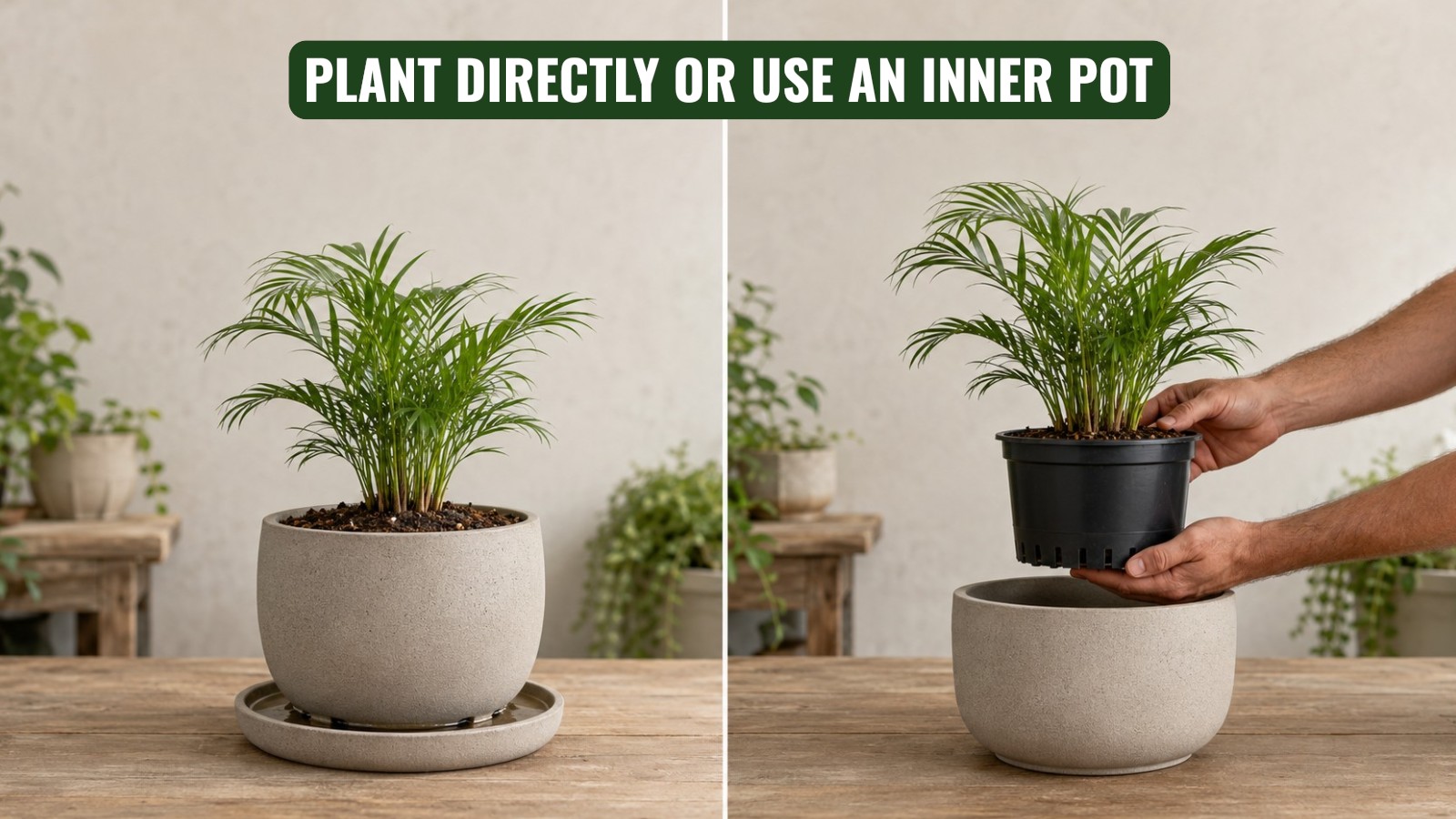
Planting directly into a planter is possible when it is sturdy, provides sufficient space and allows excess water to drain properly. Consider the final weight and whether the root ball will still be accessible during a future repotting.
An inner pot may be more practical when the plant is moved regularly, the decorative planter has no drainage holes or future repotting would otherwise be difficult. An inner pot can also reduce the total weight and make it easier to inspect the root ball.
The inner pot must remain removable. After watering, check whether water has collected at the bottom of the decorative planter and remove it. Do not leave the inner pot standing in collected water for prolonged periods. Using an inner pot therefore does not automatically make a decorative planter without drainage maintenance-free.
How do you prepare properly for repotting?
Good preparation prevents the plant from remaining out of its pot for longer than necessary. Prepare everything in advance and determine how you will safely support large, heavy, thorny or top-heavy plants.
What do you need?
Prepare:
- a suitable new pot
- substrate suited to the relevant plant
- clean gloves
- a clean and spacious work surface
- clean and sharp pruning tools for adjustments that are genuinely necessary
- suitable equipment or a second person for large and heavy plants
- protective clothing for thorny plants or plants with sharp parts
Use substrate suited to the relevant plant group. Its composition varies by species and application. Consult Substrate & drainage for information about choosing substrate, drainage holes and the construction of a planter.
How do you prepare the plant, pot and workspace?
Before you begin, check that the new pot size is suitable and that all drainage holes are clear. Prepare enough substrate and remove obstacles from the workspace. Make sure you can lay down or support the plant without damaging its leaves, trunk or growing point.
Decide in advance how you will lift a heavy plant and who will support each part. Protect yourself when handling thorny plants by using sturdy material that does not constrict or damage the plant.
If the filled pot will be difficult to move, position it in the correct location or place it on a suitable plant trolley beforehand. Do not automatically make the root ball wetter or drier. The ideal condition depends on the plant species, the substrate and the condition of the root ball.
How do you repot an exotic plant step by step?
Work calmly and keep the root ball as intact as possible. Loosening or pruning roots is not a standard step and should only be done when the situation and plant species require it.
Step 1: carefully remove the plant from its old pot
Support the pot and the base of the root ball. Carefully tilt a manageable plant and slide the pot away from the root ball. Do not pull on the trunk or leaves. This can damage vulnerable plant parts and place unnecessary strain on the roots.
If the root ball is stuck, gently press the sides of a flexible pot and loosen the edge all the way around without inserting anything deeply into the root ball. With a large plant, have one person support the plant while another removes the pot. If necessary, a stuck plastic pot can be carefully cut open.
Step 2: assess the exposed root ball
Examine how densely rooted the root ball is and how much substrate remains visible. Determine whether the plant can be transferred immediately or whether some strongly circling outer roots need to be carefully redirected. Also check whether the root ball is firm enough to be positioned without falling apart.
A healthy, cohesive root ball does not need to be opened completely. If you see abnormal roots, identify the cause first. Do not remove roots without a clear reason.
Step 3: only loosen strongly circling roots when necessary
Strongly circling outer roots can sometimes be carefully guided outwards or loosened to a limited extent. Only do this when necessary and when the plant species tolerates this treatment.
With root-sensitive plant groups, including various palms, keep the root ball as intact as possible. Do not pull healthy roots completely apart, strip the root ball bare, rinse it clean or break off roots to make the root ball fit.
Step 4: only prune roots when necessary
Root pruning is not a standard part of repotting. First determine whether the species tolerates limited correction. Avoid pruning root-sensitive plants wherever possible.
A limited correction may be necessary when a root is clearly damaged or when a severely deformed root prevents the plant from being positioned properly in the pot. Limited root correction may also sometimes be required when intentionally reusing the same pot. Use clean, sharp tools and remove no more than necessary.
Major root corrections require species-specific knowledge and are not a general solution for a pot that is too small. If the roots are soft, dark or unpleasant-smelling, consult Root rot and Root suffocation first.
Step 5: position the plant at the correct height
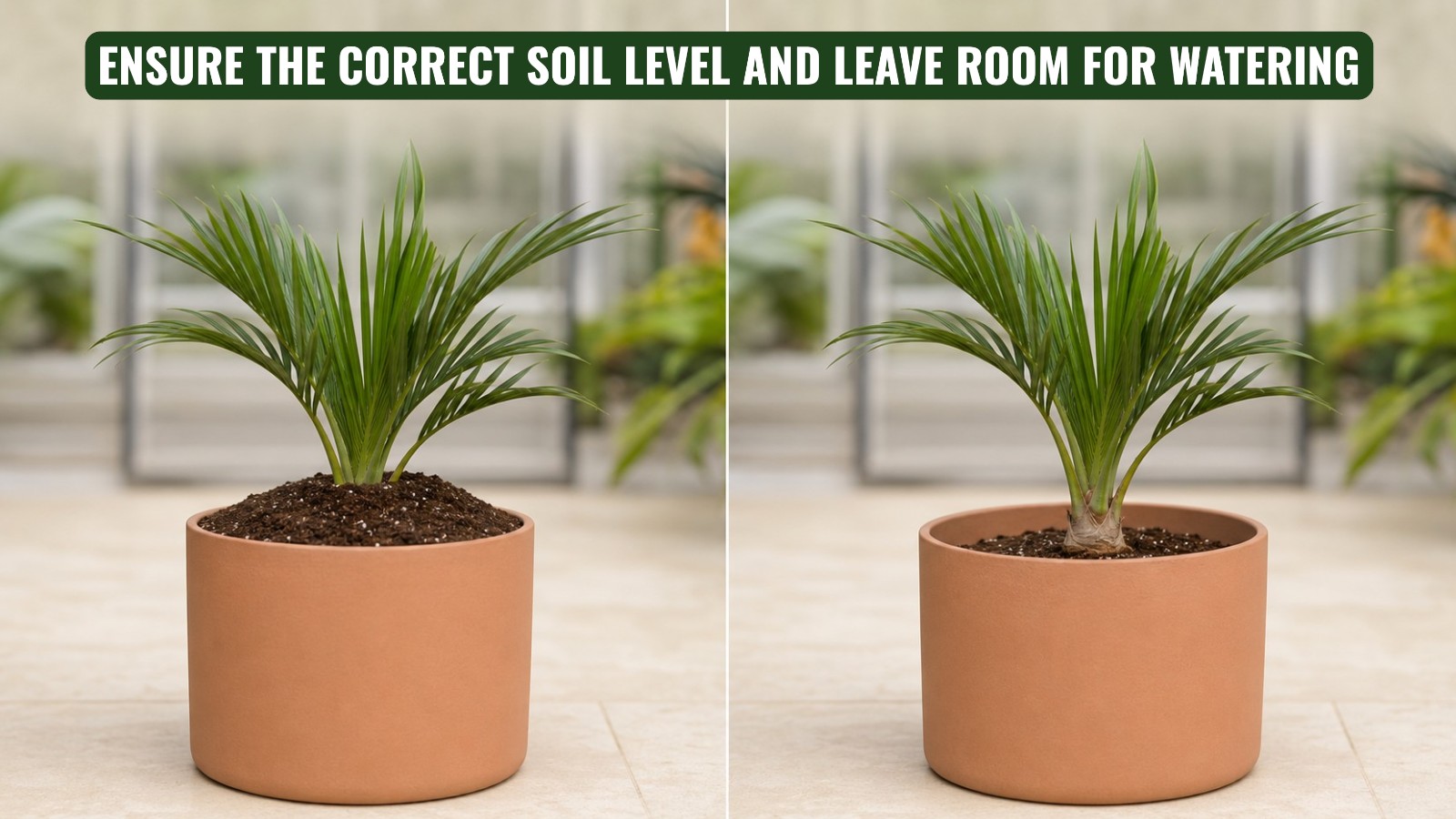
Add enough substrate to the bottom of the new pot to achieve the correct height. Place the root ball in the centre and check its position. Position the plant at approximately the same depth as it was in the old pot.
Do not bury the base of the trunk and never cover the growing point. Do not allow the top of the root ball to disappear far beneath the new substrate. Do not position the plant so high that the root ball extends above the rim of the pot or lacks sufficient support. Leave enough space below the rim to allow targeted watering later.
Step 6: fill the space around the root ball
Keep the plant upright and distribute the substrate evenly around the root ball. Add it in smaller quantities and gently guide the material into place to prevent large empty spaces.
Do not compact the substrate firmly. Regularly check that the plant remains upright and that the original planting depth is maintained.
Step 7: check the position and stability
View the plant from several sides. Check that it is upright, positioned at approximately the same depth and supported by substrate on all sides. The root ball must not move loosely inside the pot.
Then check the stability of the entire combination. A top-heavy plant must not cause the pot to tip over easily. Also check that the drainage holes remain clear and correct the position before returning the plant to its location.
What is important immediately after repotting?
After repotting, the plant primarily needs stable conditions and careful observation. Do not change several care factors at once. Moving the plant to another location, adding extra nutrients and making major changes to its conditions create an unnecessarily difficult transition.
Immediately after repotting, avoid additional stress caused by extreme heat, cold, strong wind or a sudden increase or decrease in light.
Adjust watering to the plant species, pot size, substrate and moisture level of the root ball. A larger pot does not automatically mean that the plant needs more water. Do not automatically add extra nutrients immediately either. Consult Watering and Nutrition for ongoing care.
Check that the plant remains upright and stable. Leave the root ball undisturbed and do not repeatedly remove the plant from the pot. Possible reactions after repotting and the correct approach are covered under Repotting stress.
What can you do when a larger pot is unsuitable or impractical?
With very large plants or plants that are difficult to move, a normal repotting may not always be safe or practical. Increasing the pot size further may also be undesirable. The correct choice depends on the plant species, root ball and existing pot.
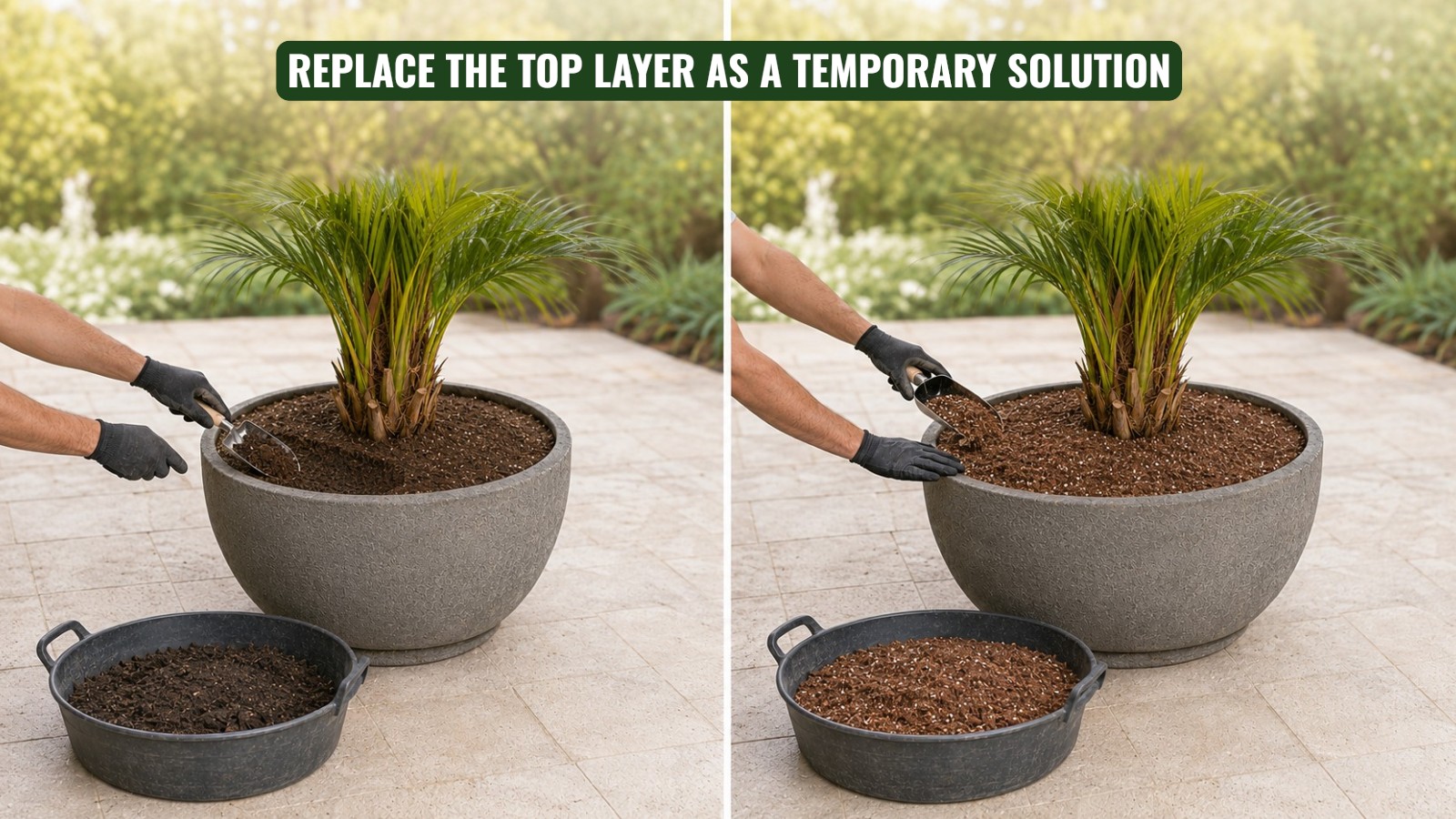
When can you replace only the top layer?
For a plant that cannot be safely removed from a large planter, replacing the top layer can be a temporary measure. Carefully remove the old top layer without digging deeply or damaging large roots. Then fill the available space with suitable substrate.
This is not a complete repotting. It does not resolve a serious lack of root space and does not allow the entire root ball to be inspected. Only use this measure when the planter still functions properly and there is no immediate reason to remove the plant.
The choice and application of material for the new top layer are covered under Substrate & drainage.
When can the same pot be reused?
The same pot can sometimes be reused when it remains sturdy and functional, but a larger pot is neither desired nor practical. Clean the pot and check that the drainage holes are completely clear.
Reusing the pot may require limited root correction. This is only responsible when the plant species tolerates the treatment and the correction is carried out carefully. This is especially important with root-sensitive plants. A major correction requires specialist knowledge and is not a standard solution for insufficient root space.
When is it advisable to seek help?
Seek practical or professional assistance when one person cannot safely handle the plant. This applies especially to heavy or tall plants, sharp thorns and planters that can only be moved with suitable equipment.
Plan in advance how the plant will be supported and where the filled pot will be placed. An uncontrolled movement can damage the plant, pot, surrounding area and yourself. Postpone the task when there is insufficient space, suitable equipment or assistance.
Common mistakes
Repotting usually goes well when you first assess what the plant truly needs. The following mistakes cause unnecessary root disturbance or result in a pot that is not properly suited to the plant.
Repotting without first checking whether it is necessary
Not every visible root means that the plant lacks space. First check the root ball, the remaining amount of substrate, the plant’s growth and the proportion between the plant and pot.
Immediately choosing a pot that is far too large
An exceptionally large pot leaves a considerable amount of unrooted substrate around a small root ball. This can make watering more difficult to assess. Choose a controlled increase in size that matches the current root ball.
Using an unstable pot or a pot without proper drainage
Check the pot before removing the plant from its old pot. The new pot must be sufficiently deep and stable. When planting directly into the pot, the drainage holes must remain clear.
Pulling the plant from the pot by its trunk or leaves
Pulling forcefully places strain on vulnerable plant parts and roots. Loosen the pot from the root ball and support the plant while tilting and removing it.
Unnecessarily loosening or pruning healthy roots
Completely pulling apart, stripping or shortening a healthy root ball is not a standard step. Limit every correction to what is genuinely necessary and appropriate for the plant species.
Positioning the plant deeper than before
Planting more deeply does not automatically provide greater stability. This can place the base of the trunk or the growing point beneath the substrate. Maintain approximately the same planting depth as in the old pot and provide stability with a suitable pot and proper support.
Compacting the new substrate too firmly
Firm compaction is not necessary to make the plant stable. Fill the space evenly and gently guide the substrate around the root ball without compacting it excessively.
Providing insufficient support for a top-heavy plant
A larger pot is not automatically more stable. Its shape, material, weight and position together determine whether the plant stands safely. Check this before leaving the plant unattended.
Changing several care factors immediately
Repotting is already a change for the plant. Moving it to substantially different conditions at the same time or adding unnecessary nutrients makes its response more difficult to assess. Keep conditions as stable as possible after repotting.
Disturbing the root ball again shortly afterwards
Do not remove the plant from the pot again shortly after repotting without a specific reason. Observe the plant above ground and only intervene when there is a clear reason to do so.
Frequently asked questions about repotting
Should a newly purchased exotic plant be repotted immediately?
No, this is not automatically necessary. First check whether the current pot provides sufficient space, is stable and functions properly. If the available root space is still suitable, the plant can first acclimatise to its new environment. This prevents the transition to a different location from being combined with unnecessary disturbance of the root ball.
Immediate repotting may be necessary when the pot is damaged or unsafe, there is a severe lack of space or another issue cannot wait. Base the decision on the condition of the plant, pot and root ball, not solely on the fact that the plant was recently purchased.
Can you repot an exotic plant while it is flowering?
Unnecessary disturbance during flowering is generally avoided. Flowering requires energy and repotting adds another change. If the current pot is still suitable and sturdy, preferably wait for a more appropriate time.
Sometimes postponement is not advisable. In the case of a cracked pot, serious instability or a clear lack of space, necessary repotting may outweigh the presence of flowers. In that case, work with extra care and minimise disturbance to healthy roots.
Related care pages
Repotting is closely connected to substrate composition, watering, feeding and the plant’s recovery. The care pages below provide additional information about these subjects.
-
Substrate & drainage – Learn more about choosing a suitable substrate and the importance of sufficient air and drainage around the roots.
-
Watering exotic plants – Discover how to adjust watering after repotting according to your plant’s needs and conditions.
-
Feeding exotic plants – Learn when you can start feeding again after repotting and how to prevent overfertilisation.
-
Root rot (Coming soon) – Learn how to recognise, prevent and properly treat root rot.
-
Root suffocation (Coming soon) – Discover how a lack of oxygen around the roots develops and what measures you can take.
-
Repotting stress (Coming soon) – Learn which temporary reactions after repotting are normal and when action is necessary.
-
Acclimatising plants (Coming soon) – Discover how to allow a plant to recover gradually and acclimatise to changed conditions.