Humidity
Humidity affects how a plant loses moisture and adapts to its environment. Many exotic plants originate from regions where the air is more humid than in the average heated indoor space. However, not every exotic plant has the same requirements. Some species grow well at normal household humidity, while humidity-loving tropical plants may require a higher level.
A suitable percentage alone is therefore not enough. Temperature, position, air circulation and care also determine how a plant responds. By measuring the humidity near the plant and assessing the entire environment at the same time, you can better determine whether adjustments are necessary.
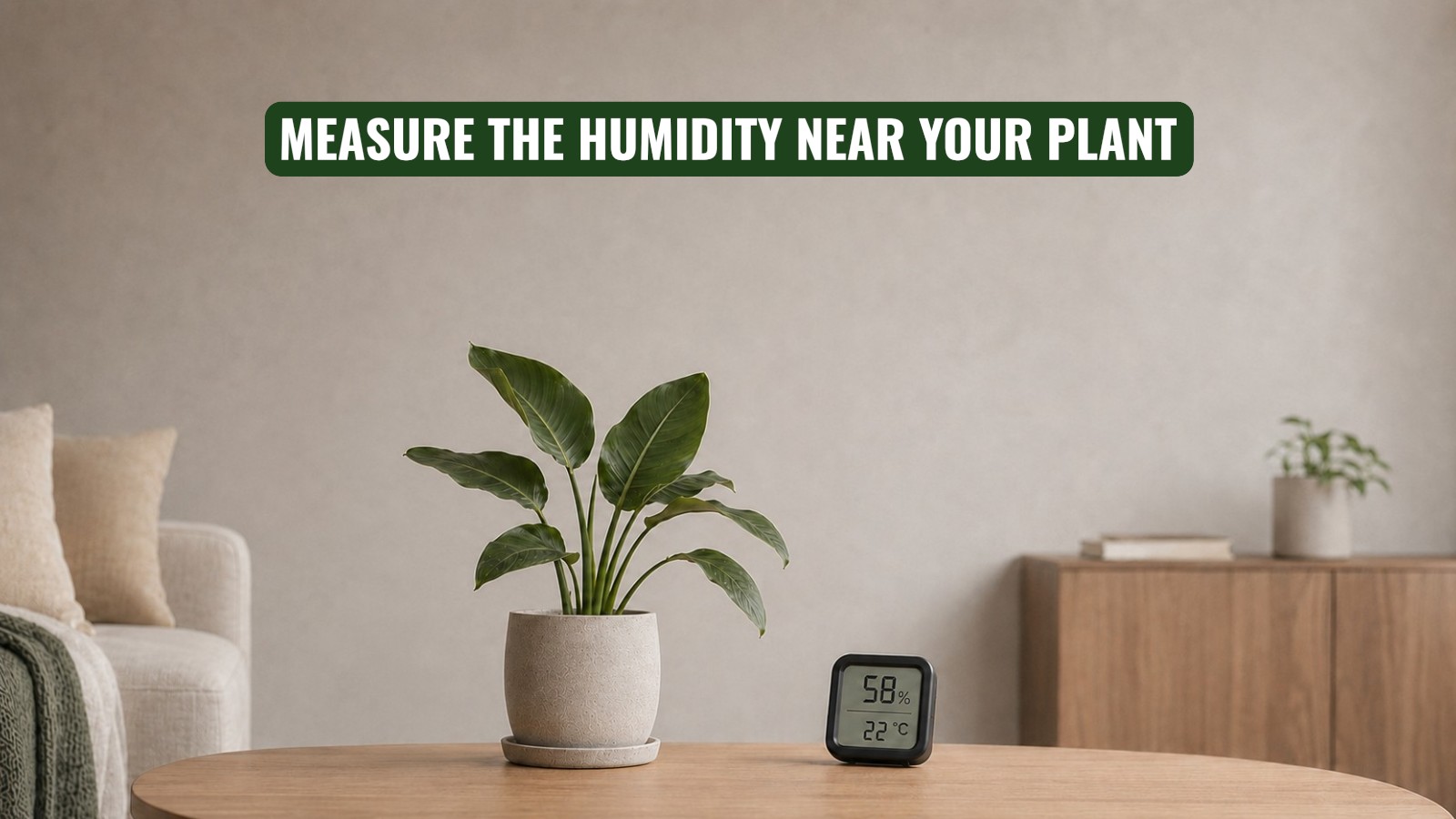
What is humidity?
Relative humidity
Relative humidity indicates how much water vapour is present compared with the amount at which the air would become saturated at the same temperature. This value is expressed as a percentage and can be measured using a hygrometer.
A relative humidity of 50% therefore does not mean that half of the air consists of water. It means that, at the measured temperature, the air contains approximately half the amount of water vapour required for saturation.
The value may change throughout the day. Heating, ventilation, outdoor temperature and how the room is used can all influence it.
Humidity is not the same as soil moisture
Humidity describes the moisture in the air around the plant. Soil moisture refers to the amount of water in the growing medium. These are two different aspects of plant care.
Higher humidity does not mean that a plant no longer needs water. The roots still absorb water from the growing medium. Conversely, giving extra water cannot safely correct low humidity. If this causes the growing medium to remain wet for too long, the roots may become damaged.
Always assess the plant’s watering needs separately. For a detailed explanation, read our information about Watering.
Temperature affects relative humidity
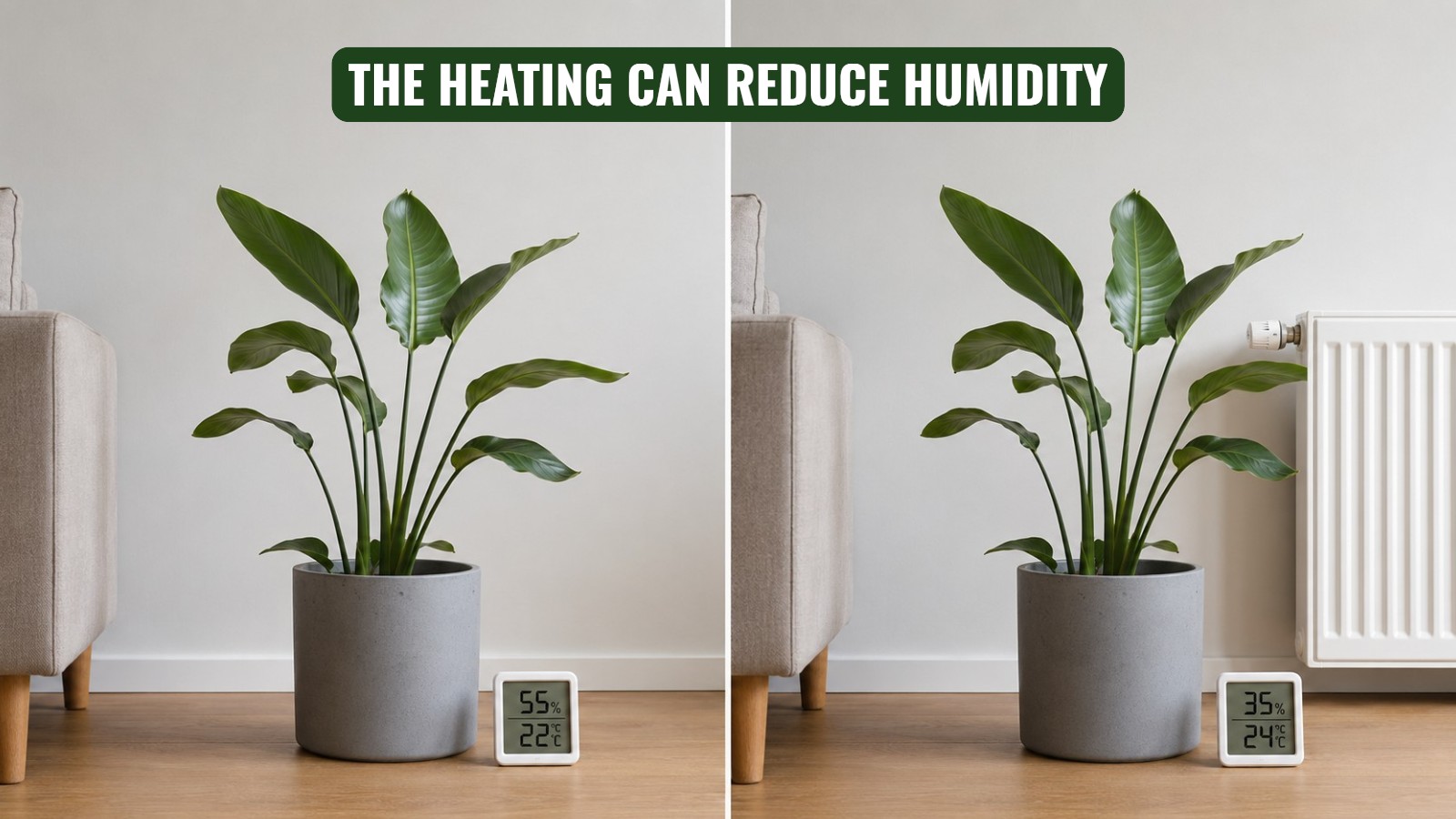
Relative humidity depends on temperature. When air is heated while the amount of water vapour remains approximately the same, relative humidity decreases. As a result, the measured indoor value can quickly fall when the heating is switched on.
When air cools, relative humidity may increase. This can cause condensation to form on cold windows and surfaces, even when the average humidity in the room does not appear exceptionally high.
Temperature and humidity should therefore be assessed together. More information can be found on the Temperature page.
What humidity level does your plant need?
General guidelines for indoor spaces
The appropriate humidity differs between plants. The percentages below are therefore general guidelines and not fixed standards for every exotic plant.
- Below 40%: may be too dry in the long term for many tropical plants. Delicate new growth and thin leaves may be particularly sensitive.
- 40 to 60%: a practical and achievable range indoors for many houseplants. For humidity-loving tropical species, especially the lower end of this range may still be too dry.
- 60 to 70%: may be suitable for various humidity-loving tropical plants, provided that moisture can dry sufficiently and the air does not remain stagnant for long periods.
- Above 70%: is not automatically harmful, but requires additional attention indoors to condensation, wet leaves, hygiene and air circulation.
A high value is not automatically better. Prolonged high humidity can become unfavourable in an enclosed space when moisture dries slowly or condensation develops.
Always consult the care information for the specific plant to determine its requirements.
Requirements differ between plants
Plants from humid tropical forests may respond differently from species originating in drier, open environments. Even plants that are both sold as tropical plants can therefore have different requirements.
Suitable humidity depends on factors including:
- the plant’s natural origin;
- the structure and thickness of its leaves;
- its growth stage;
- its position and temperature;
- the season;
- the conditions to which the plant is accustomed.
Young plants, new growth and species with thin or delicate leaves may be more sensitive to dry air. Plants with firm, thick or waxy leaves may sometimes tolerate it better, but this is not a fixed rule.
Stability is more important than one perfect percentage
You do not need to maintain one exact percentage continuously. Reasonably stable humidity within a suitable range is generally more practical than a value that repeatedly rises and falls sharply.
Large fluctuations may occur, for example, when a humidifier is briefly operated at its highest setting and then switched off completely. Adjust the conditions gradually and check the effect by taking new measurements.
How do you measure humidity?
Use a hygrometer
A hygrometer measures relative humidity. Some devices also display the temperature. This is useful because the two values are related.
Basic hygrometers may show slight deviations. Use the reading as a guide and combine it with observations of the plant and its environment. One unusual reading is generally not a reason to make major changes immediately.
Measure in the right location
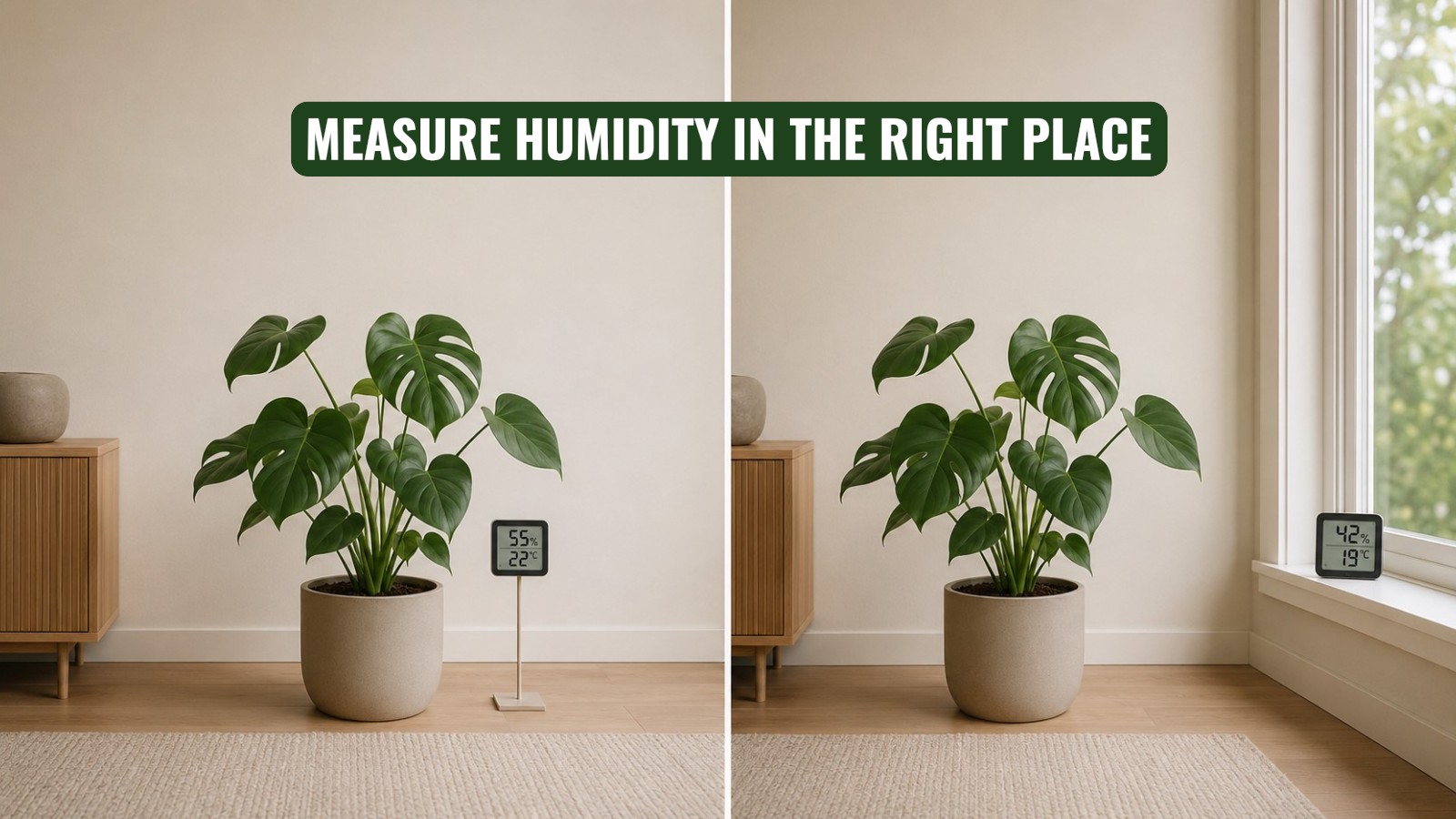
Place the hygrometer near the plant and at approximately the same height as the main part of its foliage. The meter should provide a representative indication of the conditions experienced by the plant.
Do not place the hygrometer directly:
- above or next to a radiator;
- against a cold or sunny window;
- next to the outlet of a humidifier;
- in spray mist or direct sunlight;
- near an outside door that is opened frequently;
- in front of a ventilation opening.
A meter placed directly beside a humidifier may display a much higher value than the rest of the room. A meter above a heater may produce a considerably lower reading.
Measure at different times
Humidity does not remain constant throughout the day. Several measurements taken at different times therefore provide a more reliable picture than a single reading.
For example, take measurements:
- when the heating is switched on and off;
- before and after ventilating the room;
- during warm and cold weather;
- in different seasons.
Focus mainly on the overall pattern. A brief increase or decrease does not necessarily indicate a problem. A value that remains outside the suitable range for a prolonged period gives more reason to assess the situation.
How do you recognise unsuitable humidity?
Possible signs of dry air
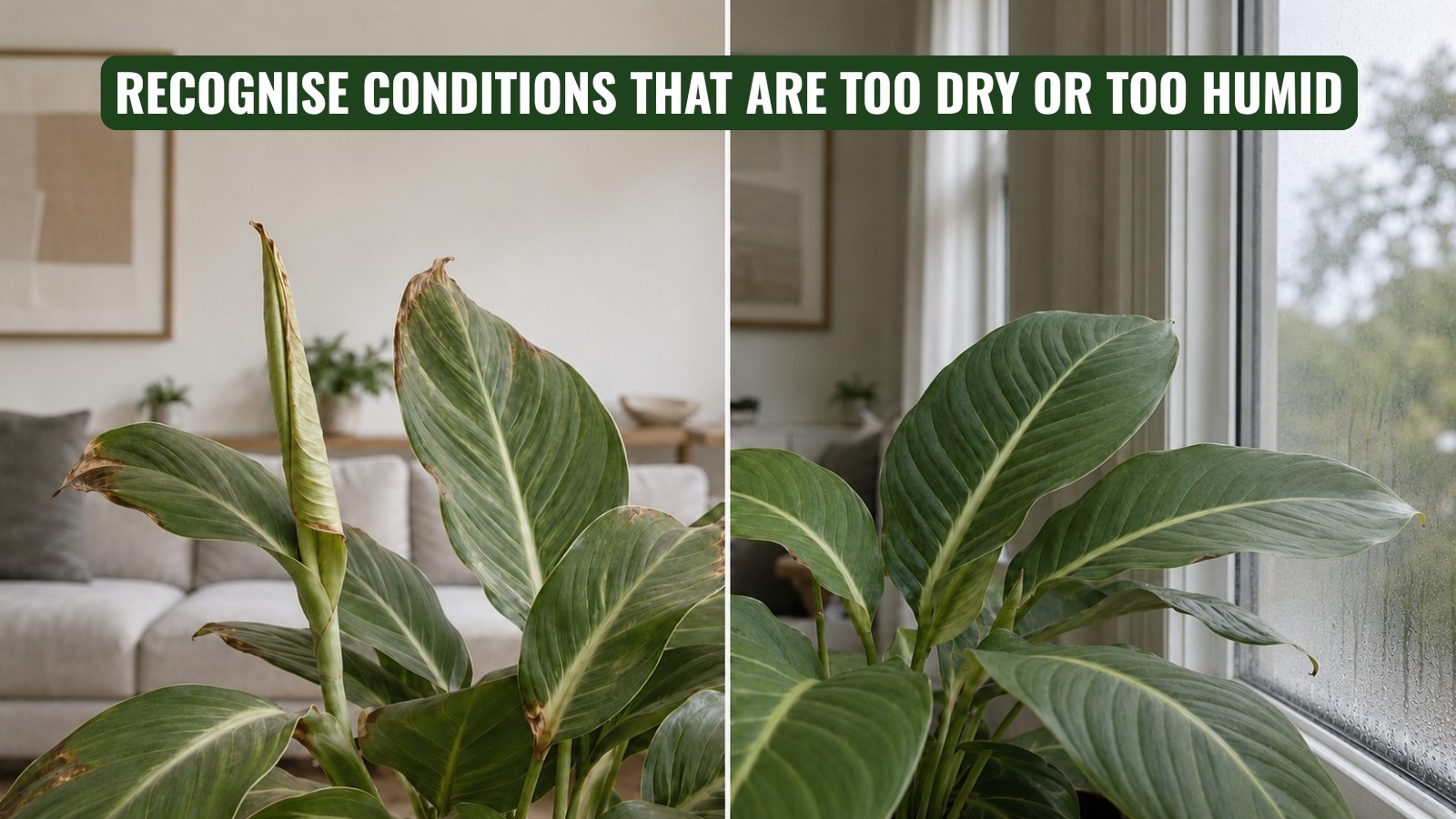
Prolonged low humidity may contribute to the following symptoms in sensitive plants:
- dry or brown leaf tips;
- drying leaf edges;
- delicate new growth that dries out more quickly;
- young leaves that unfold with difficulty or fail to open completely.
Under certain conditions, a plant may also lose moisture more quickly, causing the growing medium to dry faster between waterings. This comparison is only useful when factors such as temperature, light, pot size and the composition of the growing medium have remained approximately the same.
These symptoms do not prove that humidity is too low. Brown leaf tips and damaged new growth may also be caused by watering practices, root problems, salts, fertilisation, temperature, light or pests.
Possible signs of prolonged humid conditions
High humidity becomes particularly unfavourable when moisture cannot dry properly. Look out for:
- recurring condensation on windows and surfaces;
- leaves that remain wet for long periods;
- damp materials around the plant;
- spray mist that dries slowly;
- a stuffy environment with little air movement;
- visible mould growth on damp surfaces.
A high reading without these conditions is not automatically harmful. The combination of prolonged moisture, insufficient air circulation, wet leaves and an unsuitable temperature presents a greater risk of problems.
Always assess the entire situation
A symptom may have several possible causes. Therefore, check not only the humidity but also:
- the temperature;
- watering;
- the amount of light;
- the growing medium and roots;
- air circulation;
- possible diseases or pests.
Giving extra water, spraying extensively or immediately setting a humidifier to its highest level without first checking the conditions may make another problem worse.
What causes humidity to change?
Heating and temperature
Relative humidity often decreases in heated indoor spaces. During cold periods in particular, this can create a substantial difference between the outdoor climate and the heated indoor environment.
A plant that grows well without additional humidification in summer may therefore experience different conditions during the heating season.
Ventilation and air circulation
Ventilation removes indoor air and replaces it with other air. Its effect on humidity depends on the temperature and moisture content of that air. Cold outdoor air, for example, may result in low relative humidity once it has warmed up indoors.
Air circulation is different from ventilation. Circulation moves the air already present, while ventilation exchanges it. Gentle air movement can help prevent humid air from remaining stagnant around wet leaves and surfaces.
The plant’s position
Conditions can vary considerably within a single room. Pay particular attention to plants placed near:
- radiators and other heat sources;
- cold or sunny windows;
- outside doors;
- ventilation openings;
- air-conditioning units;
- humidifiers.
Moving the plant to a more stable position may sometimes be enough to reduce large fluctuations.
Seasons and use of the room
Humidity changes throughout the year. Heating often plays a major role in winter. During warmer periods, open windows, outdoor temperatures and ventilation have more influence.
Showering, cooking, drying laundry and the number of people in a room can also temporarily produce additional moisture. Check the values again when the season, heating or use of the room changes.
How do you increase humidity?
Use a humidifier
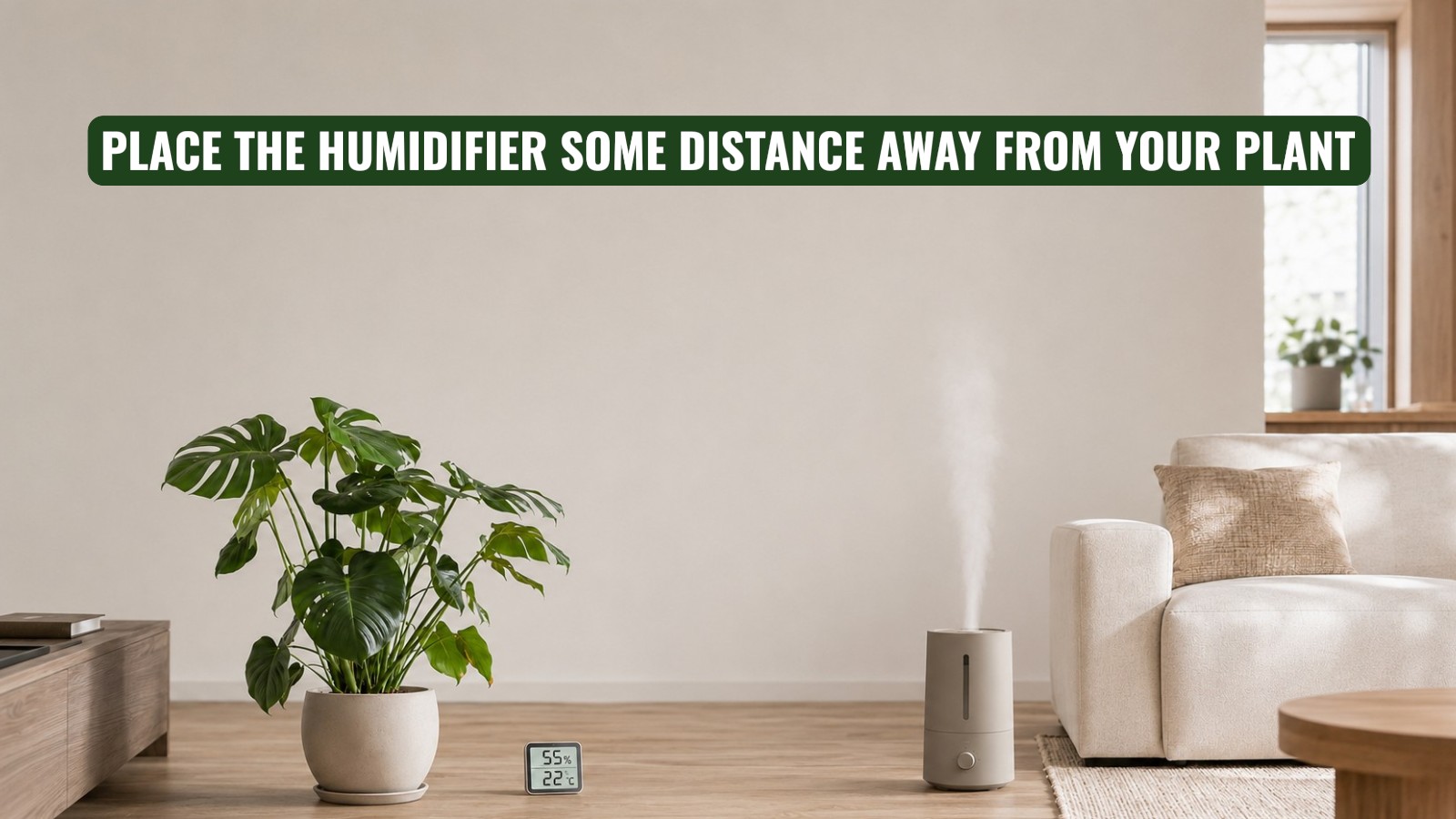
A humidifier is generally the most targeted and controllable way to increase humidity in a room. Use it together with a hygrometer placed some distance from the outlet.
Pay attention to the following:
- do not place the device directly against the plant;
- do not continuously direct the outlet towards the leaves;
- keep sufficient distance from windows, walls, furniture and electrical equipment;
- prevent leaves and surfaces from remaining wet for long periods;
- check regularly for condensation;
- use water that is suitable for the device;
- clean and maintain the device according to the manufacturer’s instructions.
Stagnant or contaminated water may reduce hygiene. Replace the water regularly and do not set the device higher than necessary.
Group plants together
Plants release moisture into their surroundings through transpiration. Placing several plants together may create a slightly more humid local microclimate.
The effect depends on the number and size of the plants, the temperature, air circulation and the size of the room. Use a hygrometer to check whether this actually makes a difference in your situation.
Do not place plants so close together that their leaves constantly touch and air can barely circulate.
Choose a more suitable position
A more stable position may be more suitable than one where conditions constantly require correction. Moving a plant away from a radiator or ventilation opening may sometimes have more effect than additional humidification.
Also consider light and temperature when choosing another position. A room with higher humidity is not automatically suitable if it does not provide sufficient light.
Misting and water trays
Misting the leaves generally increases humidity only briefly and locally. It is not a substitute for controlled room humidification when the air remains too dry for long periods.
Misting may be unfavourable when:
- leaves remain wet for a long time;
- there is little air movement;
- water collects in the leaf axils or growing point;
- the plant is sensitive to wet leaves;
- hard water leaves stains or deposits.
A bowl of water or a pebble tray may have a limited local effect, but generally does little to increase humidity throughout an entire room. When using a pebble tray, make sure that the pot is not continuously standing in water.
Only use these methods as supplementary measures and check their actual effect.
How do you reduce humidity?
Ventilate effectively
When humidity remains too high for a prolonged period, ventilation can help remove humid indoor air. Take the weather and outdoor temperature into account.
Do not leave a sensitive plant in a strong, cold draught for long periods. Brief and effective ventilation may be more suitable than leaving the plant next to an open window for several hours. Check the humidity and temperature again afterwards.
Improve air circulation
Gentle air movement helps distribute moisture more evenly around plants, leaves and surfaces, allowing wet areas to dry more quickly.
Do not continuously direct a strong airflow from a fan at the plant. The purpose is to create gentle circulation in the room, not strong wind around the leaves.
Identify the cause
Possible causes of a persistently high reading include:
- a humidifier set too high;
- insufficient ventilation;
- substantial moisture production in an enclosed room;
- recurring condensation;
- wet surfaces;
- laundry drying indoors;
- taking measurements directly next to a source of moisture.
Where possible, address the cause first. Continuously ventilating without dealing with the source of the moisture may not be sufficiently effective.
Common misconceptions
Confusing humidity with soil moisture
Giving extra water does not safely correct dry air and may cause the growing medium to remain wet for too long.
Using one ideal value for every plant
Not every exotic plant has the same requirements. Always check the information for the specific species.
Measuring in an unsuitable location
A hygrometer next to a radiator, window or humidifier may not provide a representative reading.
Taking immediate action after one measurement
First assess the pattern at different times and check the entire environment.
Automatically attributing brown leaf tips to dry air
Brown leaf tips can have several causes. Also check watering, the roots, fertilisation, water quality, temperature, light and possible pests.
Using misting as a complete solution
The effect is generally temporary. Leaves that remain wet for long periods may also cause problems.
Failing to consider maintenance and seasonal changes
Clean a humidifier according to the manufacturer’s instructions and reassess the conditions when the heating, ventilation or season changes.
What can you check today?
- Measure the humidity near the plant using a hygrometer.
- Check the value at several representative times.
- Compare the measurements with the requirements of the specific plant.
- Also assess the temperature, watering, position and air circulation.
- If necessary, adjust the conditions gradually and then measure again.
Frequently asked questions about humidity
What humidity do exotic plants need?
This differs by species. For many houseplants, 40 to 60% is a practical range. Humidity-loving tropical plants may require a higher level. Always check the plant’s specific care information.
Is high humidity always better?
No. Higher humidity may be suitable for humidity-loving plants, but it must be combined safely with an appropriate temperature, sufficient air circulation and good hygiene.
Where should I place a hygrometer?
Place the meter near the plant and approximately at foliage height. Avoid placing it directly beside a radiator, window, outside door, ventilation opening or humidifier.
Why does humidity decrease when the heating is on?
When air is heated while the amount of water vapour remains approximately the same, relative humidity decreases. The heating does not necessarily remove moisture directly, but changes the ratio on which the percentage is based.
Does misting plants help?
Misting may briefly increase humidity around the leaves, but the effect is generally temporary and local. It is not a substitute for controlled humidification of the room.
Does placing a bowl of water next to the plant help?
The effect is generally limited and local. Use a hygrometer to check whether it makes a measurable difference in your situation.
Can dry air cause brown leaf tips?
Yes, dry air may contribute to this. However, brown leaf tips may also be caused by problems with watering, roots, fertilisation, salts, temperature, light or pests.
Should I adjust the humidity in winter?
This may be necessary because heating often reduces relative humidity indoors. Measure near the plant first and only adjust the conditions if the value remains unsuitable for the specific species for a prolonged period.